
Shops most often ask for a Certificate III in Barbering or an apprenticeship in progress, backed by a portfolio and a trial cut. Legal requirements differ by state and local council, so check current rules with both before you apply or advertise. Skill you can show usually carries as much weight as paper.
Most barber job ads say 'qualifications required' and stop there. That line is often copied from a general hairdressing template, so barbers are left guessing and shops end up screening the wrong people. Both sides lose time.
This guide sets out what Australian barbershops actually look for, how to prove it, and how to write requirements that fit the chair you are filling. It also explains how BarberRise checks credentials before a profile shows as verified. We are only for barbers and barbershops, so the advice is built for one trade.
Key Takeaways
- Whether a formal qualification is legally required depends on your state and local council. Check current rules with both rather than relying on a blog post, including this one.
- The Certificate III in Barbering is the formal qualification most shops recognise. An apprenticeship in progress is also widely accepted.
- A portfolio and a trial cut often carry as much weight as a certificate. Prepare both.
- Overseas and visa-holding barbers should bring evidence of skill and experience. Visa questions go to a registered migration agent, never to a job board.
- Shop owners should match requirements to the chair type and separate must-haves from nice-to-haves.
- A BarberRise profile shows as verified only after we have checked the credentials attached to it.
Built only for barbers and barbershops
Barbers: tell us where you want to cut and when, and shops see you first. Shops: post a role free, and your first placement is free as a founding shop.
Get startedQualifications at a Glance
| Pathway | What it shows | How shops use it | Best suited to |
|---|---|---|---|
| Certificate III in Barbering | Formal, nationally recognised training | Often listed as preferred or required | Full-time and trial-to-permanent chairs |
| Apprenticeship in progress | Training under way with a working employer | Accepted for junior and developing roles | Apprentices and career changers |
| Hairdressing qualification | Related technical foundation | Accepted if barber-specific skills are shown | Hairdressers moving into barbering |
| Short specialist course | Depth in one skill, such as razor work or beard design | Treated as a bonus, not a substitute | Qualified barbers adding services |
| Portfolio and trial cut | Proof of what you can do in the chair | Often decides the final choice | Everyone, including overseas-trained barbers |
Is a formal qualification legally required to work as a barber in Australia?
It depends on where you work. Rules on training, premises, hygiene and razor work differ by state and local council, and they change over time. We do not state a single rule here. Check current requirements with your state government and your local council before you start cutting or advertise a chair.
The legal question and the hiring question are separate. Even where the law does not demand a particular certificate to take a chair, a shop owner can still set their own bar. They carry the risk if a barber turns out to be unsafe with a razor or poor with hygiene, so many set that bar high.
Here is a practical way to settle the legal side:
- Ask your local council about premises and hygiene requirements for the shop, and whether razor services trigger extra obligations.
- Ask your state government (start with the relevant health or business regulator) whether any training or registration applies to barbers.
- Ask your insurer. Policies often set their own expectations about training and services offered.
- Check the Fair Work Ombudsman for pay, apprentice and contractor questions. It covers employment rules, not licensing.
If you are a barber, keep a simple folder of your certificates, references and any course records. If you are a shop owner, put the outcome of your checks into the listing in plain language. Do not guess, and do not copy a line from another ad.
Which qualifications do Australian barbershops ask for?
Australian shops most commonly ask for the Certificate III in Barbering, an apprenticeship in progress, or a related hairdressing qualification. Short courses in specialist skills add weight but rarely replace the core training. What counts most is how each one maps to the chair on offer.
Certificate III in Barbering
This is the formal qualification most shops recognise. It is delivered through TAFE and private training organisations. TAFE NSW lists it as SHB30516 on its Certificate III in Barbering course page, including the units taught. Training packages are updated from time to time, so confirm the current code and unit list on training.gov.au.
For a barber, the certificate answers one question for a shop: has this person been trained in the fundamentals? For a shop owner, reading the unit list tells you what a graduate has actually been taught. That helps you decide what you still need to test in a trial.
Apprenticeship status
Many shops hire apprentices and say so in the listing. If you are mid-apprenticeship, say that clearly and say what you have completed so far. Evidence can include your training contract details, your training organisation and a reference from your current employer. Australian Apprenticeships explains how apprenticeships work and what support exists.
Shop owners taking on apprentices should check pay and conditions with the Fair Work Ombudsman rather than assuming. The rules for apprentices differ from those for fully qualified staff.
Related hairdressing qualifications
A hairdressing qualification is a real foundation. Cutting theory, hygiene and client care carry across. But barbering has its own demands: skin fades, clipper-over-comb work, razor shaves, beard shaping and line-ups. A hairdresser moving across should show those skills in a portfolio and expect a trial cut to test them.
Short courses in specialist skills
Short courses in areas such as razor shaving, beard design or colour show you have invested in a niche. Treat them as a bonus. List them under your core qualification, with the provider and the year. A shop that wants a straight-razor specialist will care about this more than any other line on your profile.
Skill versus paper: why a portfolio and trial cut carry so much weight
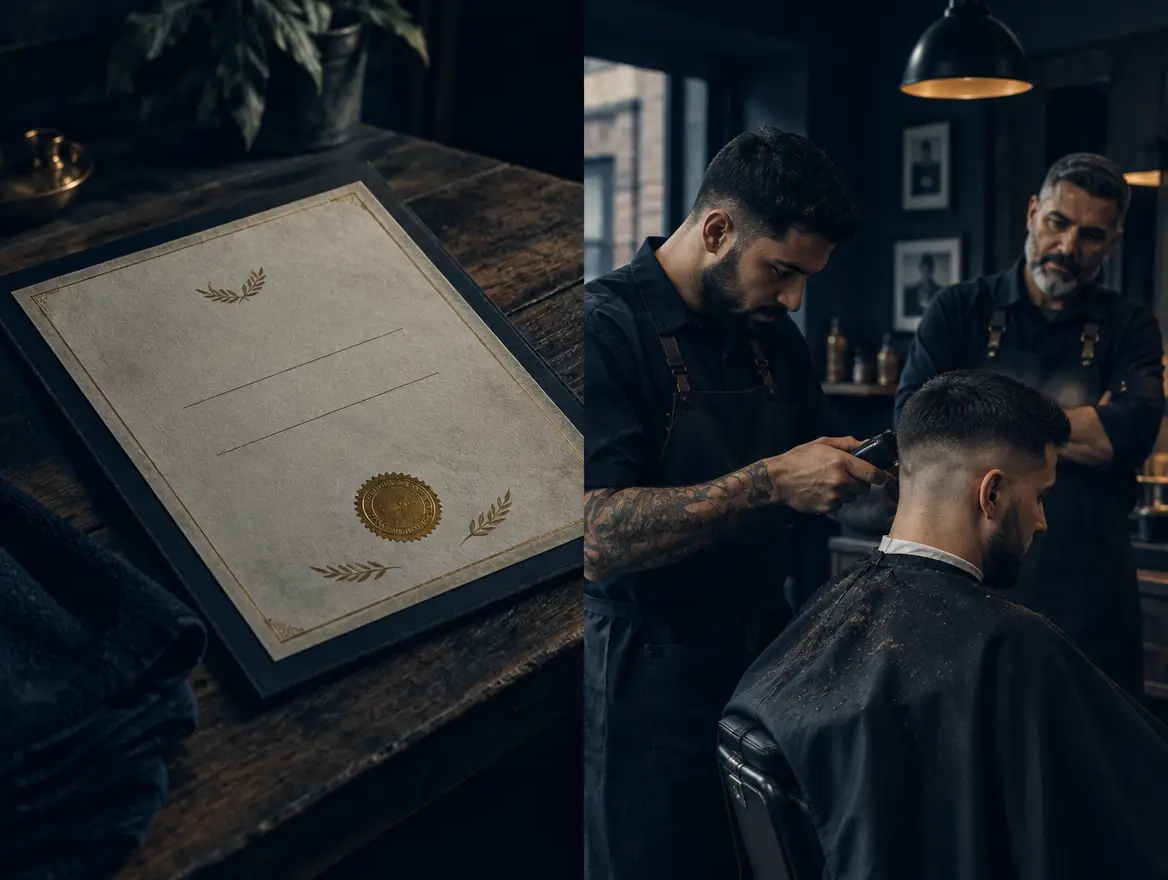
A certificate shows you were trained. A portfolio and trial cut show you can cut. Shop owners know a client in the chair does not care what is on the wall. That is why many hiring decisions come down to demonstrated skill, with the qualification as a supporting signal.
How to present a portfolio
Keep it tight and honest. Ten strong photos beat fifty average ones.
- Show range: skin fades, tapers, scissor work, textured cuts, beard trims and line-ups.
- Use clean, consistent photos from the same angles: front, side and back.
- Include work on different hair types, because a shop's clientele is rarely uniform.
- Show only work that is yours. A shop will find out at the trial.
- Add a line on what you did and how long it took where it matters.
How to approach a trial cut
A trial is not only about the haircut. Owners watch the consultation, your station hygiene, your pace and how you talk to the client. Arrive early, bring your own tools in good order and ask what the shop expects to be finished in the time.
Shop owners should be careful here. Trial shifts and pay are covered by workplace law, so check the Fair Work Ombudsman guidance before you set one up. Put the arrangement in writing so both sides know what to expect.
What should overseas and visa-holding barbers know about qualifications?
Overseas-trained barbers should bring proof of training, references and a strong portfolio, then ask a registered migration agent about visa and formal recognition questions. BarberRise never gives visa advice. Shops generally judge skill first, but visa rules sit outside what any job board can answer.
We built the platform with barbers from the UK, Canada and New Zealand in mind. If that is you, you can tell shops where you are heading and when, months before you land. Shops see you before you reach the open market, and you can line up a chair before you arrive. The Australia Ready pass is there to get you ready to cut here.
What to gather before you land:
- Certificates and training records from your home country, in English or with a translation.
- Reference letters from past shop owners, with contact details.
- A portfolio that shows range, including fades and razor work.
- A clear note on your availability and the chair type you want.
For visa questions, speak to a registered migration agent and check the official Department of Home Affairs information. We cover where sponsorship conversations are happening in our visa sponsorship barber jobs by city coverage, but that is market information, not advice. Hold your documents ready so a shop can say yes quickly if the visa side works out.
How should shop owners write qualification requirements?
Write requirements for the chair, not for a template. State what is essential, what is preferred and how you will test it. Show pay up front. A clear listing attracts the right barbers and saves hours of sifting for both sides of the chair.
BarberRise supports five placement types: full-time, trial-to-permanent, rostered, short cover and rent-a-chair. Each one calls for a different bar.
| Chair type | Sensible requirement | Watch out for |
|---|---|---|
| Full-time | Certificate III in Barbering or equivalent proven skill, plus references | Asking for years of experience you cannot explain |
| Trial-to-permanent | Proven skill plus a trial cut that leads into a defined review | Unclear pay and expectations during the trial |
| Rostered | Qualification or proven skill, plus availability that fits your roster | Listing hours vaguely |
| Short cover | Ready-to-go skill and references, minimal ramp-up time | Requiring paper you do not need for a short fill |
| Rent-a-chair | Evidence they run their own business, typically an ABN, plus insurance and a portfolio | Treating a contractor like an employee |
Rent-a-chair is the one to get right. The legal difference between an employee and a contractor matters, so check the Fair Work Ombudsman before you set terms. Do not list a certificate as essential for a chair where it is not.
A few writing rules that work:
- Separate must-haves from nice-to-haves. 'Certificate III in Barbering or equivalent demonstrated skill' is clearer than 'qualifications required'.
- Say how you will test skill. Name the trial cut and what it involves.
- Show the pay. Barbers filter out ads that hide it.
- Describe the clientele and services. A fade-heavy shop and a classic cut-and-shave shop need different barbers.
- Be honest about the chair. If it is a 6am open, say so.
Posting a role on BarberRise is free. We charge 0% agency commission and never take a percentage of wages. The first placement is free for founding shops. If you want to hire your way, you choose the placement type and write the bar yourself.
How does BarberRise verify barber credentials?
A BarberRise profile shows as verified only after we have checked the credentials attached to it. Verification means the paper behind the profile has been reviewed. It does not replace a trial cut, but it removes one unknown before you even speak to the barber.
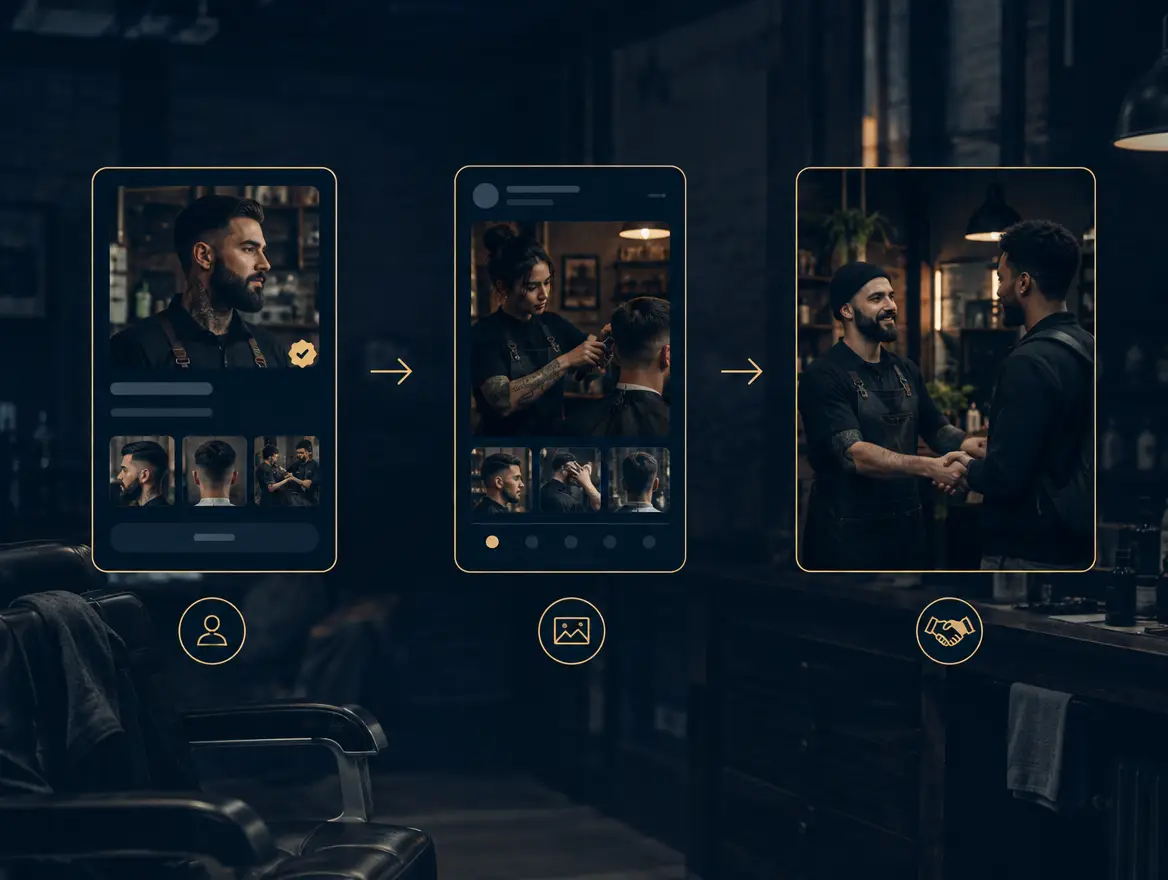
Here is how it fits into our model, which we call Three steps. Both sides.
- Create your profile. Barbers add experience, portfolio and credentials. Shops describe the chair.
- Post or browse. Shops post a role, and barbers browse roles built for the trade.
- Connect and work. Both sides talk, trial and agree terms.
The point of verification is time. On a generic board, a shop posts an ad and sifts through unscreened applicants for hours. On BarberRise, roles go to barbers already screened for them, and applications arrive with portfolio and experience attached. We are not Seek. We are not Indeed. Only barbers, only barbershops.
If you are a barber, create a profile and upload your credentials to get verified. A verified profile tells shops you are serious. If you are a shop, post a role free, with clear requirements and pay shown up front.
Verification is also one part of a bigger picture. We run three tiers on the platform: community, education and job placement. Skills get you started. A community gets you further.
Why a certificate is not the same as a chair-ready barber
Our founder, Justin, has ten years in the trade and has managed three shops. His view after all that is blunt: qualified on paper and chair-ready are two different things, and a good listing should say which one it needs.
A certificate tells you someone completed training. It does not tell you how they handle a busy Saturday, a difficult consultation or a client who wants a cut the hair will not hold. Some of the best chair-ready barbers he has worked beside learned much of it on the floor. Some of the weakest on a Saturday had every certificate going. That is why we put the portfolio and trial cut next to the credential, not under it.
He has also seen the other side. In his Canadian shops, Justin ran an academy and trained barbers from scratch. He invested in developing new staff, and they were poached within months. That experience shaped how we think about hiring. Shops need to find people who are already close to chair-ready, and they need a reason for those people to stay.
Later, running Black Sheep Barbershop on the Gold Coast, he lived the 6am opens, the no-shows and the staff hunts. It is hard to step away from the chair while keeping every chair filled. He built BarberRise inside his own shop so owners could hire from barbers already screened for the chair, instead of hunting through Facebook groups, DMs and generic job boards. A full shop runs itself. An empty chair runs you.
Here is our contrarian position. Stop writing 'Cert III required' on every listing out of habit. Write what the chair needs. If a rent-a-chair spot needs a barber with a following and their own business, ask for that. If a full-time spot needs a strong fader who fits your team, say so and test it. And barbers, do not rule yourself out because one line on one ad says 'qualified'. Build the profile, show the work and find your chair.
We also think education should support a career behind the chair, not just a grind. Technique gets you in the door. Health, ergonomics, business skills and community are what keep the trade working for you in year fifteen.
References
- TAFE NSW, Certificate III in Barbering course page
- training.gov.au, national register of training packages and qualifications
- Australian Apprenticeships, information on apprenticeships and traineeships
- Fair Work Ombudsman, workplace rights and obligations
- Department of Home Affairs, visa and immigration information
Frequently asked questions
Do you need a licence to be a barber in Australia?
It depends on your state and local council. Rules on training, premises, hygiene and razor work vary, and they change. Check current requirements with your state government and local council before you start cutting or advertise a chair. Do not rely on a general article for this.
Do you need a Certificate III in Barbering to get a barber job?
Not always. Many shops prefer or require it, especially for full-time chairs, but others weigh a portfolio and trial cut just as heavily. Apprenticeships in progress are also common. Read each listing closely and ask the shop what they actually need.
Can overseas-trained barbers work in Australian barbershops?
Overseas-trained barbers can and do apply, and shops often judge skill first through a portfolio and trial. Work rights are a separate matter. BarberRise does not give visa advice, so speak to a registered migration agent and check the Department of Home Affairs.
What does verified mean on a BarberRise profile?
It means BarberRise has checked the credentials attached to the profile before the verified status shows. It is not a guarantee of performance in the chair. Shops should still run a trial cut and check references.
How much does it cost to post a barber job on BarberRise?
Posting a role is free. BarberRise charges 0% agency commission and never takes a percentage of wages. The first placement is free for founding shops.
Find a chair near you
Every city, by state: barber jobs in Australia and hairdressing jobs in Australia. Pay floors and how each pay structure works: what barbers get paid.

BarberRise
The team building Australia's job platform for barbers and barbershops.
Keep reading
barber qualifications and experience requirements
Barber Qualifications and Experience Requirements: What Australian Shops Ask For and How to Show You Meet Them
17 min read
visa sponsorship barber jobs by city
Visa Sponsorship Barber Jobs by City: How to Find Sponsoring Barbershops in Australia
18 min read

local salary benchmarks
Local Salary Benchmarks for Barbers: How to Compare Pay Across Australian Cities and Regions
16 min read