
Chair rental opportunities let a barber pay a shop a set rent, usually weekly, to use a chair while keeping their own takings and working on their own ABN. The best way to find one is a trade-only board that shows the rent and terms up front, so you can compare before you commit.
Chair rental is one of several chair types in Australian barbering, but it gets buried on generic job boards among salaried and commission roles. A barber scrolling past hundreds of unrelated listings rarely finds the one rental chair that fits. A shop owner with an empty chair gets a pile of unscreened applicants who wanted a wage.
This guide is written from the trade, by a team led by a founder with ten years behind the chair and three shops managed. It explains how rental works, who it suits, what a solid agreement spells out, how shop owners can fill a chair fairly, and which red flags to walk away from. It gives no legal or tax advice. Where the rules matter, we point you to the ATO and the Fair Work Ombudsman.
Key Takeaways
- Chair rental means you pay the shop rent, keep your takings and work on your own ABN. It is not a wage and not commission.
- It suits barbers with a strong rebooking rate, a loyal client book and the discipline to run their own marketing, bookings and admin.
- A good agreement puts the rent, inclusions, hours, notice period, pricing control and exclusivity in writing before day one.
- Shop owners fill rental chairs faster by stating the rent openly, checking credentials first and explaining what the rent includes.
- Vague rent, hidden fees and a 'rental' chair controlled like employment are the main red flags.
- A board built only for barbers and barbershops puts rental chairs in front of role-matched people, with terms shown up front.
Built only for barbers and barbershops
Barbers: tell us where you want to cut and when, and shops see you first. Shops: post a role free, and your first placement is free as a founding shop.
Get startedSummary Table: Chair Types in Australian Barbering
| Chair type | How you are paid | Who it suits | What to check first |
|---|---|---|---|
| Full-time | Wage from the shop | Barbers wanting stable income and set hours | Award or agreement rates, hours, leave |
| Trial-to-permanent | Wage during a trial, then ongoing role | Barbers and shops testing the fit | Trial length, pay during the trial, what permanent looks like |
| Rostered | Wage or rate for set shifts | Barbers wanting flexibility across shifts | Roster notice, minimum shifts |
| Short cover | Paid for a defined gap | Barbers between roles or covering leave | Dates, rate, expectations |
| Rent-a-chair | You pay rent, keep your takings | Barbers with a client book who want independence | Rent, inclusions, notice period, pricing control |
What Does Chair Rental Mean in Australian Barbering?
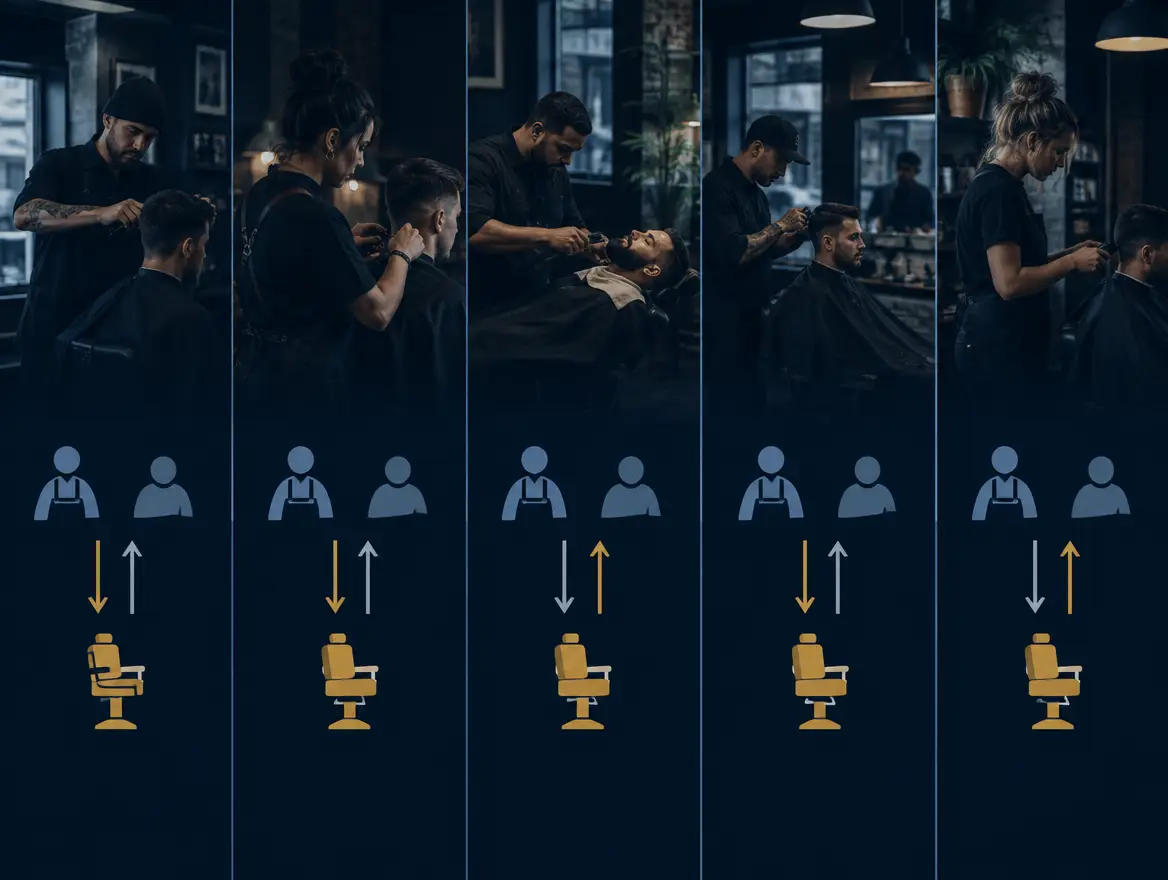
Chair rental means you pay the shop a fixed rent, usually weekly, for the use of a chair and keep your takings from clients. You work on your own ABN, run your own books and carry your own risk. It differs from wage, commission and trial-to-permanent chairs, where the shop sets pay and usually controls more.
The five chair types side by side
BarberRise supports five placement types: full-time, trial-to-permanent, rostered, short cover and rent-a-chair. Each suits a different stage of a barber's career and a different gap in a shop.
On a wage chair, the shop pays you whether the diary is full or quiet. On a commission chair, you and the shop split what you earn. On a rental chair, the split disappears. You pay the rent, and the rest is yours, minus your own costs.
That is the appeal. It is also the risk. A quiet week still has a rent due.
What 'keeping your takings' really covers
Keeping your takings does not mean keeping everything as profit. You still cover tax, super, insurance, your tools, any products the rent does not include and your time off. Nobody pays you for sick days or holidays on a rental chair.
That is why a barber comparing rental against a wage should look at local salary benchmarks for barbers, then work out what weekly takings would beat a wage after rent and costs. Rents vary by city and suburb, so a figure from another town will not help you.
Contractor or employee: where the line sits
Calling an arrangement 'rental' does not make it one. Whether someone is a contractor or an employee depends on the real working relationship, not the label on the paperwork. Who sets the hours? Who sets the prices? Who owns the clients? Who provides the tools?
The Australian Taxation Office and the Fair Work Ombudsman both publish guidance on employee versus independent contractor status. Read it before you sign or offer a rental arrangement, and speak to an accountant or a lawyer about your own situation. We do not give legal or tax advice, and neither should a job board.
For shop owners, the stakes run in the other direction. A chair that looks like rental but is run like employment can land you in a sham contracting dispute. The path from fades to Fair Work is shorter than most owners think.
Is Renting a Barber Chair Right for You?
Renting suits a barber with a steady rebooking rate, a loyal client book and the discipline to run their own marketing, bookings and admin. If your diary only fills because the shop sends you walk-ins, renting moves the risk onto you. Test your numbers before you sign anything.
Rebooking rate comes first
Rebooking is the number that decides whether rental works. If most of your clients book their next cut before they leave the chair, your income is predictable. If most are one-off walk-ins, your income depends on the shop's foot traffic, and you are paying rent for something you do not control.
Check your own diary. How many of your clients came back in the last two months? How many found you through the shop's signage or the shop's page, and how many followed you?
A loyal client base travels with you
A barber who has built a following can fill a rental chair within weeks. A barber who is still building one may find the first month lean. That does not rule rental out, but it does mean you need a buffer for the rent and your living costs while the diary fills.
If you are earlier in your career, a trial-to-permanent or rostered chair builds clients while the shop carries the risk. Rental can come later.
Can you run the business side?
On a rental chair, you are a small business. That means:
- Managing your own bookings and no-shows
- Marketing yourself on social media and Google
- Keeping records, lodging your own tax and managing GST if it applies to you
- Carrying insurance suited to your work
- Planning for slow weeks, sick days and time off
Some barbers love that. Others find it drains the energy they would rather spend on the craft. Be honest about which you are.
Self-employed barbers in Australia also need to think about the long game. Your hands, back and shoulders are the business. Ergonomics and health matter in year fifteen as much as technique matters in year one. A career behind the chair, not just a grind, means building a model you can sustain.
What Should a Barber Chair Rental Agreement Spell Out?
A solid agreement states the rent amount, what the rent covers, your hours, the notice period, who controls pricing and whether the arrangement is exclusive. Put it in writing before day one. If a term matters to you, it belongs on the page, not in a conversation.
This is a checklist, not legal advice. Have a lawyer or your accountant review any agreement before you sign.
Rent amount and payment
The agreement should state the rent, how often it is due, how it is paid and what happens if a payment is late. It should also say whether the rent changes during the term and how much warning you get. Weekly is common, but the listing and the agreement should say so clearly.
What is included
This is where hidden costs live. Ask what the rent covers, item by item:
- Products and consumables
- Towels and laundry
- Booking system access
- Utilities, Wi-Fi and cleaning
- Tools, clippers and the chair itself
- Shop signage, online listing and marketing
- Card payment facilities and any fees on them
If something is not listed as included, assume it is extra and ask what it costs.
Hours and access
Can you open when you want? Is there a minimum number of days? Can you come in early or stay late? A true rental chair gives the renter control over their own hours, within reasonable shop opening times. If the shop dictates your roster, ask yourself what you are really paying for.
Notice period
Both sides need a fair way out. The agreement should state how much notice either party gives to end the arrangement and what happens to the chair, any bookings and any shop-held client data. A one-sided notice period, where you owe weeks but the shop owes days, is worth questioning.
Pricing control
The renter normally sets their own prices, because they carry the risk. If the shop sets your prices, that is a sign the arrangement leans towards employment. Agree who sets prices in writing, and whether there are any shop-wide rules, such as a minimum price to protect the shop's positioning.
Exclusivity
Does the agreement stop you cutting elsewhere? Does it stop you taking clients with you when you leave? Does it stop the shop renting another chair to someone offering the same services? Exclusivity cuts both ways. State it clearly so nobody is surprised six months in.
How Shop Owners Can Set Fair Rent and Fill a Rental Chair
Set rent by looking at what the chair gives the renter: location, foot traffic, facilities and what is included. Check licences and credentials before the chair is taken, and state the rent openly in the listing. Fair rent you can explain fills faster than a vague number that invites haggling.
Setting rent without guessing
Rents vary by city and suburb, so we do not quote an average here. A chair in a busy Sydney strip and a chair in a regional town are different products. Look at comparable listings in your area, think about what you provide, and ask what it costs you to keep the chair available.
Price it so a barber with a solid book can make it work. A rent that only works for a fully booked barber will leave the chair empty, and an empty chair costs you every week.
Check credentials before they sit down
Check qualifications and any registrations or insurances that apply to the work before the chair is handed over. Ask for evidence of training, such as a Certificate III in Barbering or equivalent experience, a portfolio and references. Check what your state, territory or local council requires for the premises and the services offered.
Your name is on the door. A renter's standard of work and hygiene reflects on your shop. On BarberRise, credentials are checked before a profile shows as verified, so you are not starting from zero.
State the rent in the listing
Hiding the rent until a phone call wastes both sides' time. Barbers filter out listings without numbers, and they should. Put the rent, what it includes, the hours and the notice period in the listing. You will get fewer enquiries, and they will be the right ones.
Posting a role on BarberRise is free. Agency commission is 0%, and it is never a percentage of wages. The first placement is free for founding shops.
Decide what kind of chair you actually need
Some owners say they want a renter when what they need is a wage barber they can roster. Be honest. If you need to control hours, set prices and direct the work, you are looking for an employee. If you want a self-managed professional who brings their own clients, rental fits. Choose the chair type that suits the shop, then hire your way.
What Are the Red Flags When You Rent a Barber Chair?
The main red flags are a vague or shifting rent, hidden fees, and a 'rental' chair the shop controls like employment. If the shop sets your hours, prices and clients but calls you a contractor, get advice. Clear numbers up front are the simplest test.
Vague or moving rent
Be wary of 'rent depends on how you go' or 'we will sort it out when you start'. A rent that is not stated cannot be compared, and it can change after you have moved your clients across. Ask for the figure in writing.
Hidden fees
Watch for extras that appear after you start: booking system fees, product charges, laundry, card fees, marketing contributions or a 'shop levy' on top of the rent. None of these is automatically wrong. Each should be listed before you agree.
Rental in name, employment in practice
This is the big one. Warning signs include:
- The shop sets your roster and expects you to cover set shifts
- The shop sets your prices and takes a cut of each service
- The shop assigns you clients and directs how you cut
- You are expected to wear a uniform and follow scripts
- The shop controls the booking system and owns the client data
Some of these may be reasonable in isolation. Together they point to employment dressed up as rental, which can leave a barber without leave, super or award protection. Read the ATO and Fair Work guidance, and take advice if the arrangement feels off.
Pressure to commit fast
A good chair does not need a same-day decision. If you are pushed to sign before reading the agreement or visiting the shop at a busy time, step back.
Where Can You Find Barbershop Chairs for Rent?
Look where barbers and barbershops already are: a trade-only board, your own network and local shops you can walk into. A trade-only board saves the most time because listings are role-matched, show terms up front and link to verified credentials, rather than burying rent chairs among unrelated jobs.
Why generic boards waste your time
Generic job boards are built for every industry. A rental chair sits next to warehouse roles and retail shifts, and there is rarely a filter for rent-a-chair. Shop owners then sift through unscreened applicants, and barbers scroll through roles that were never meant for them.
Facebook groups and DMs are no better. Posts disappear in hours, terms are rarely stated, and nobody checks anything.
What a trade-only board changes
BarberRise is only barbers, only barbershops. We are not Seek and we are not Indeed. That focus changes four things:
- Role-matched: a rent-a-chair listing reaches barbers who want that chair type, not everyone job hunting.
- Terms shown up front: rent and inclusions sit in the listing, so you compare before you apply.
- Verified credentials: barbers show a verified profile once credentials are checked.
- Portfolio attached: applications arrive with experience and work samples included.
Barbers moving from the UK, Canada or New Zealand can also tell shops where they are heading and when, months before they land. Shops can see who is coming to their city before those barbers reach the open market. Visa questions always go to a registered migration agent, because we never give visa advice.
City pages, role-type pages, local salary benchmarks, nearby location listings and barber manager roles all sit on one board, so you can compare a rental chair against a wage or a management role in the same place.
Three steps, both sides
The process is the same whether you are the barber or the shop:
- Create your profile. Barbers build a verified profile. Shops set up their shop page.
- Post or browse. Shops post a chair for free. Barbers browse listings in their city.
- Connect and work. Agree the terms, put them in writing and start.
What Ten Years and Three Shops Taught Us About Empty Chairs
Our founder, Justin, has ten years in the trade and has managed three shops. His view is simple: a full shop runs itself, and an empty chair runs you. Most rental problems come from poor matching and unclear terms, not from bad barbers or bad owners.
At Black Sheep Barbershop on the Gold Coast, Justin lived the 6am opens, the no-shows and the hunt for staff. He found it hard to step away from the chair while keeping every chair filled. Hiring meant digging through Facebook groups, DMs and generic job boards. He built BarberRise inside his own shop so owners could hire from barbers already screened for the chair.
Earlier, in Canada, he ran an academy inside his shops and trained barbers from scratch. The new staff were poached within months. The economics of training people who then walk shaped how he sees retention. Owners need to find the right barber for the right chair type, not just any barber, and both sides should know the terms from the start.
Here is our position on rental, and it is not neutral. Rental is the most misunderstood chair in the trade. Done well, it gives an experienced barber independence and gives a shop a full chair without the wage bill. Done badly, it gives the barber all the risk and the shop all the control. The difference is almost always whether the terms were stated up front.
That is why we built a board where rent-a-chair is one of five placement types, not an afterthought. Skills get you started. A community gets you further. Rise together means both sides of the chair know what they are signing.
If you are a barber ready to work for yourself, build a verified profile and browse listings in your city. If you are a shop owner with an empty chair, post it free, show the terms up front and pay no commission. Find your chair, or fill it.
References
- Australian Taxation Office, guidance on employees and independent contractors
- Fair Work Ombudsman, independent contractors
- Australian Business Register, ABN information
Frequently asked questions
What is chair rental in a barbershop?
Chair rental means a barber pays the shop a set rent, usually weekly, to use a chair and keeps their own takings from clients. The barber works on their own ABN and manages their own bookings, tools, tax and insurance. It differs from wage and commission arrangements, where the shop pays the barber.
Do I need an ABN to rent a barber chair?
Rental chairs are normally run by self-employed barbers working on their own ABN. Your obligations around tax, GST and super depend on your circumstances. Check the Australian Business Register and ATO guidance, and speak to an accountant. BarberRise does not give tax or legal advice.
How much does it cost to rent a barber chair in Australia?
Rents vary by city and suburb, and by what the rent includes, such as products, towels and booking systems. Look for listings that state the rent and inclusions openly, and compare what you get for the money.
Is a barber who rents a chair an employee or a contractor?
It depends on the real working relationship, not the label. Who controls hours, prices, clients and tools all matter. The Fair Work Ombudsman and the ATO publish guidance on contractor versus employee status. If an arrangement is called rental but is controlled like employment, get independent advice.
Does it cost shops to post a rental chair on BarberRise?
Posting a role is free. Agency commission is 0% and is never a percentage of wages. The first placement is free for founding shops. Shops can post a rent-a-chair listing, show the rent and terms up front and receive applications from barbers already screened for the role.
Find a chair near you
Every city, by state: barber jobs in Australia and hairdressing jobs in Australia. Pay floors and how each pay structure works: what barbers get paid.

BarberRise
The team building Australia's job platform for barbers and barbershops.
Keep reading

barber jobs by state
Barber and Hairdressing Jobs by State: How to Find the Right Chair Anywhere in Australia
18 min read

Barber colour specialist jobs
Barber Colour Specialist Jobs: How to Find or Fill a Colour Chair in Australia
17 min read

barber job market FAQs
Barber Job Market FAQs: Straight Answers About Finding or Filling a Chair in Your City
15 min read