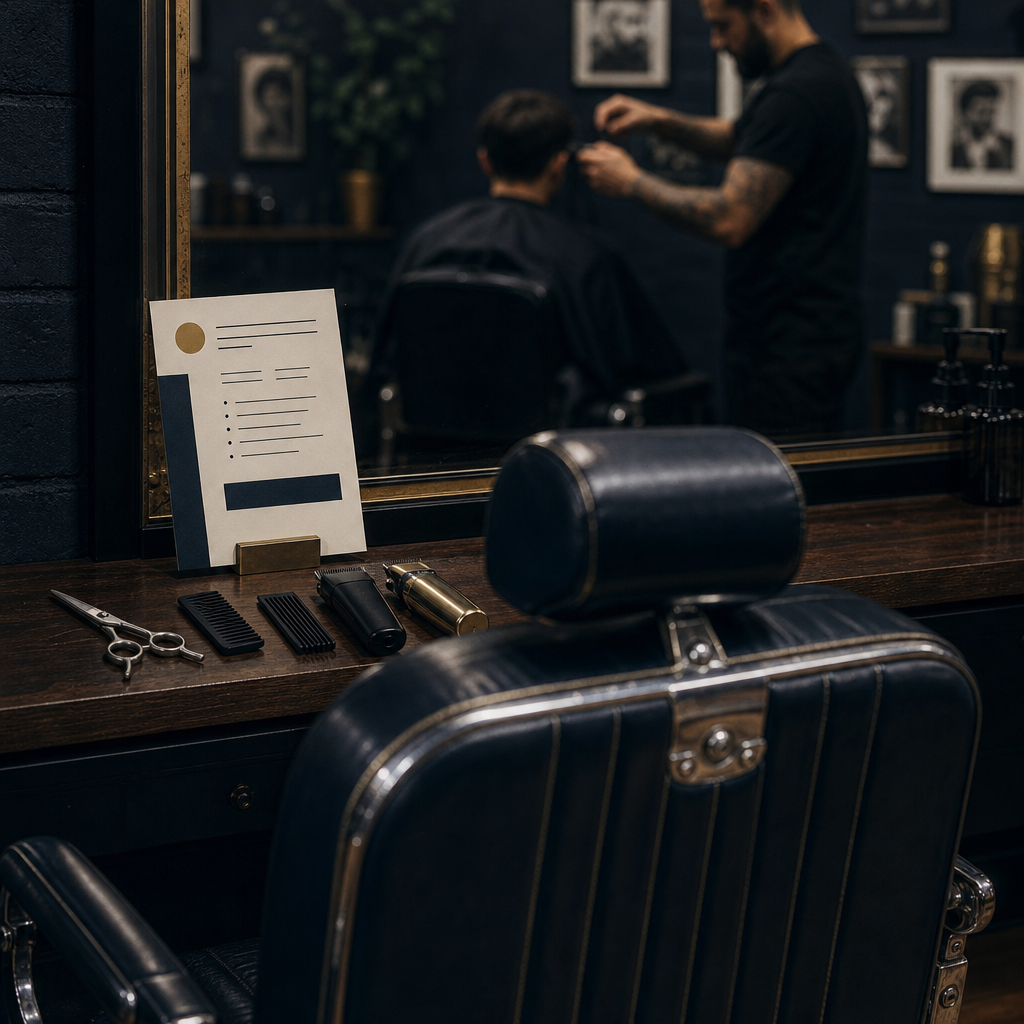
A barber job salary range is the lowest and highest pay a shop will offer for a specific chair, shown in the listing itself. The bottom usually reflects experience and the top reflects skill, client book and hours. Always check it against the current Hair and Beauty Industry Award on the Fair Work website.
Most barber listings on general job boards say "competitive rates", "DOE" or "pay negotiable". That one missing line is where most wasted time starts. Barbers send applications, wait, interview, and only then learn the chair was never viable. Shops sift people they could never afford to keep.
This guide is written mainly for barbers comparing open chairs, with a dedicated section for shop owners writing their next listing. You will learn how to read a range, what the common pay structures mean, which red flags matter, and how to write a range that fills a chair faster. We do not quote dollar figures here, because the rates that apply to you depend on your award classification, hours and employment type.
Key Takeaways
- A visible pay range is the fastest filter a barber has for deciding whether a chair is worth an application.
- The bottom of a range usually reflects experience and the top reflects skill, client book and hours worked.
- Wage, wage plus commission and rent-a-chair are different arrangements with different legal and tax outcomes. The label in the listing does not decide which one applies.
- Missing or vague pay is a red flag, not proof of a bad shop, but it should prompt questions before you apply.
- Shops that post an honest range get fewer mismatched applications and shorter hiring cycles.
- BarberRise is only for barbers and barbershops. Pay is shown up front, posting is free and there is 0% agency commission.
Built only for barbers and barbershops
Barbers: tell us where you want to cut and when, and shops see you first. Shops: post a role free, and your first placement is free as a founding shop.
Get startedSummary Table
| Listing element | What it tells a barber | What to check |
|---|---|---|
| Visible range | The shop has set a budget and will stand behind it | Whether the range matches the hours and duties |
| Pay basis (hourly, weekly, annual) | How the figure was built | Hours per week and penalty rates |
| Base plus commission | Part of your income depends on your bookings | How commission is calculated and when it is paid |
| Rent-a-chair | You are running your own business | Contractor status, insurance and tax obligations |
| Trial-to-permanent | A paid assessment period leading to ongoing work | Pay during the trial and the review date |
| "DOE" or "competitive" | The shop has not committed to a figure | Ask for the range before you invest time |
Why "Pay Negotiable" Costs Everyone Time

Hidden pay wastes time because barbers apply, wait and interview before learning whether the chair is viable, while shops sift applicants who never fit their budget. A visible range filters both sides before anyone sends a message. The trawl-and-apply cycle on general boards exists largely because pay is left out.
Here is how it plays out. Consider a qualified barber looking for a full-time chair. They open a general job board and see dozens of hairdressing, beauty and retail roles mixed in with barbering. Many say "competitive". They apply to ten, hear back from three, and find at the interview stage that two are well below what they need.
Now flip it. Imagine a shop owner who has posted the same kind of listing. They receive a pile of applications from people with no chair experience, no portfolio and no sense of the hours. They then spend evenings sorting through them, often after a full day behind the chair.
Neither side did anything wrong. The format failed them. A general board is built to move as many applications as possible, not to match a barber to a chair. That is why we say it plainly: we're not Seek, we're not Indeed. It is a board for barbers and barbershops, nothing else.
The cost is not only hours. For a shop, an empty chair means lost bookings and pressure on the rest of the team. A full shop runs itself. An empty chair runs you. Every week spent on a mismatched hiring cycle is a week the chair stays empty.
How to Read a Barber Salary Range

To read a barber salary range, first identify the pay basis (hourly, weekly or annual), then check the hours it assumes, then see whether commission or tips sit on top. Two ranges that look different may describe the same income. Convert everything to the same basis before you compare chairs.
Hourly, weekly and annual figures
Shops quote pay in different ways, and the basis changes what the number means.
- Hourly: common for casual and part-time roles. Check whether penalty rates for evenings, weekends and public holidays are included or paid on top.
- Weekly: often used for full-time rostered roles. Confirm how many hours the week assumes.
- Annual: usually found on full-time or management-track roles. Ask whether it includes superannuation, because a package figure and a base figure are not the same thing.
A useful habit is to turn every listing into the same basis before comparing. A 38-hour week with a shop that closes Sundays is a different job from a six-day roster that happens to pay a similar weekly number.
Base plus commission
Many barber roles combine a base wage with commission on services or product. A range for these roles often covers the guaranteed part only, or a blended figure that assumes a full book.
Ask three questions. What is the guaranteed base? What does commission apply to? When does a new barber typically reach a full book at this shop? A range that explains this in the listing is worth far more than one that says "earn what you're worth".
What the bottom and top of a range usually reflect
The bottom of a range generally reflects a barber who is qualified but still building speed, consistency and clientele. The top generally reflects a barber who can fill their own book, handle a wider service menu and work independently from day one.
Three factors usually move you along the range:
- Experience: years behind the chair and the range of clients you have handled.
- Skill specialisation: a barber who is strong in skin fades, beard work, long hair or hot towel shaves may sit higher than a generalist, because those skills fill a specific gap in the shop.
- Client book: if you can bring regulars with you or fill your diary quickly, you are worth more at the top end.
This is why pay varies by skill. A shop that needs a specialist will often pay more for that specialisation than the general range implies. A good listing says so.
Pay Structures You Will See in Barbering Listings
Barber listings usually fall into three pay structures: a straight wage, a wage plus commission, or a rent-a-chair arrangement where you run your own business. Chair type then adds another layer: full-time, part-time, casual or trial-to-permanent. Each combination changes how stable your income is and who carries the risk.
Wage, wage plus commission and rent-a-chair
Straight wage: you are an employee paid for the hours you work. This tends to suit apprentices and barbers who want predictable income while they build a book.
Wage plus commission: you receive a base and earn more as your bookings grow. It rewards a strong client book, but your income depends partly on how well the shop fills your diary.
Rent-a-chair: you pay the shop for a chair and keep what you earn. You are generally running your own business, with your own insurance, tax and super obligations. Whether someone is genuinely a contractor depends on the substance of the arrangement, not what the listing calls it. The Fair Work Ombudsman and the ATO both publish guidance on the difference between employees and contractors, and it is worth reading before you sign anything.
How chair type changes the picture
Barbering placements on BarberRise cover five types: full-time, trial-to-permanent, rostered, short cover and rent-a-chair. Here is what each usually means for pay.
- Full-time: the most stable income, with the pay basis often weekly or annual.
- Part-time and rostered: set days or shifts, often hourly. Useful if you are building a second income or studying.
- Casual and short cover: flexible and often hourly, with the casual loading governed by the award. Good for filling gaps or testing a shop.
- Trial-to-permanent: a paid assessment period leading to ongoing work. Ask what you are paid during the trial and when the review happens.
- Rent-a-chair: no wage at all. Your income is whatever you earn after chair costs.
Checking the award: from fades to Fair Work
We do not quote award rates in this article, because they change and depend on your classification, age, hours and employment type. Instead, check them yourself. The Hair and Beauty Industry Award sets minimum pay and conditions for much of the trade, and Fair Work publishes the current rates and a Pay and Conditions Tool.
This is the bit we call Fades to Fair Work. If a listing's range sits below what the award requires for your role, that is a problem. If it sits above, you now have a basis for negotiation. Either way, you are working with facts rather than guesses.
Red Flags When Pay Is Missing or Vague
Missing pay is not always a bad sign, but it is a reason to ask questions before you spend time on an application. The most common red flags are "DOE" with no range, "earn what you're worth", commission-only offers for entry-level roles, and unpaid trials with no end date.
Watch for these patterns:
- "Competitive" with nothing else. Competitive against what? If a shop will not name a range, ask yourself why.
- "DOE" on every listing. Depends on experience is fair when the shop also gives a range. On its own, it leaves all the negotiating power with the shop.
- Commission-only for a new starter. If the shop has not built your book and you carry all the risk, check whether this is really an employment role.
- Unpaid or vaguely paid trials. A trial should have a defined length, defined hours and a clear pay arrangement. Fair Work has guidance on unpaid trials, and they are not always lawful.
- A rent-a-chair offer dressed up as a job. If you are told you will be an employee but are asked to bring your own insurance and pay for your chair, something does not add up.
- No hours listed. A salary figure without hours is not a salary figure.
One vague line is a prompt to ask. Several together are a reason to look at a different chair. A shop that is confident in what it offers has no reason to hide it.
For Shops: How to Write a Pay Range That Fills a Chair Faster
A good pay range names the pay basis, the hours, the structure and what moves a barber from the bottom to the top. It filters out mismatched applicants and attracts barbers who fit. Shops that publish honest ranges spend less time sifting and more time cutting.
If you own or manage a shop, here is how to write one.
- Start with the award. Check the current Hair and Beauty Industry Award through Fair Work so your range never sits below the legal minimum for the role.
- Name the basis. Say whether the range is hourly, weekly or annual, and state the hours it assumes.
- Be specific about structure. If it is base plus commission, say what the base is, what commission applies to and how often it is paid.
- Say what moves a barber up the range. Name the skills you want, such as skin fades, beard work or hot towel shaves, and the client book you expect.
- State the chair type. Full-time, part-time, casual, trial-to-permanent, rostered, short cover or rent-a-chair. Each attracts a different barber.
- Keep the range honest. If your real budget tops out at one number, do not advertise a higher one. Barbers talk, and a mismatch costs you trust.
A narrow, honest range tends to beat a wide, aspirational one. A very wide range makes barbers assume they will land at the bottom. A range that matches your real budget attracts people who will accept the offer.
The cost of posting should never be the barrier. On BarberRise, posting a role is free, and there is 0% agency commission on a placement. We never take a percentage of wages. For founding shops, the first placement is also free. Hire your way, with the chair type that suits your shop.
How BarberRise Listings Show Pay Up Front Alongside Verified Credentials
BarberRise is a board built only for barbers and barbershops, so every listing is for a chair and every listing shows pay up front. Credentials are checked before a profile shows as verified. That means a barber can see the pay and a shop can see who is qualified, before either side starts a conversation.
Here is what that looks like in practice.
- Pay shown up front. Listings carry a visible range, so a barber can rule a chair in or out in seconds.
- Verified credentials. A profile only shows as verified once credentials are checked, so shops are not guessing.
- Portfolio and experience attached. Applications arrive with the work, not just a CV.
- Five placement types. Full-time, trial-to-permanent, rostered, short cover and rent-a-chair, so both sides choose the arrangement that suits them.
- Roles go to screened barbers. A role goes straight to barbers already screened for it, instead of landing in an inbox with hundreds of unrelated applications.
It works in three steps for both sides: create your profile, post or browse, connect and work. Only barbers, only barbershops.
For barbers moving from the UK, Canada or New Zealand, the same visible pay helps you plan before you land. We do not give visa advice, and visa questions always go to a registered migration agent. Fair Work's award information still applies to work done here.
Barbers: browse open chairs with pay shown and create a free profile. Find your chair.
Shops: post a role free, with pay up front, and claim a free first placement as a founding shop.
The DOE Problem From Both Sides of the Chair
The contrarian view we hold is this: a pay range is not a negotiating weakness for the shop. It is a commitment that separates serious shops from the rest. Hiding pay protects a shop from nothing except good applicants who know their worth.
Our founder, Justin, has ten years in the trade and has managed three shops. That means he has seen "DOE" from both sides of the chair. From the owner's seat, it feels like flexibility: you do not want to lock yourself into a number before you have met the person. From the barber's seat, it feels like being asked to bid blind.
Both views are understandable. Neither works. The owner who hides pay gets applicants who assume the worst, and the barber who applies blind accepts a chair without knowing whether it fits.
Justin also owned Black Sheep Barbershop on the Gold Coast. He lived the 6am opens, the no-shows and the staff hunts, and the difficulty of stepping away from the chair while keeping every chair filled. Hunting through Facebook groups, DMs and generic job boards was part of that. He built BarberRise inside his own shop so shops could hire from barbers already screened for the chair.
He also ran an academy inside his Canadian shops, training barbers from scratch. Those staff were poached within months. That experience shaped his view of what shops need from recruitment and retention: clarity from the first line of the listing, and a platform where both sides know what they are agreeing to.
This is the view behind everything we build. Education that outlasts hustle culture. A career behind the chair, not just a grind. Skills get you started. A community gets you further. And none of it works if the first thing a barber sees is a pay line that says nothing. Rise together starts with a number on the page.
References
- Fair Work Ombudsman. Hair and Beauty Industry Award [MA000005] summary. https://www.fairwork.gov.au/employment-conditions/awards/awards-summary/ma000005-summary
- Fair Work Ombudsman. Pay and Conditions Tool (PACT). https://calculate.fairwork.gov.au/
- Fair Work Ombudsman. Independent contractors. https://www.fairwork.gov.au/find-help-for/independent-contractors
- Australian Taxation Office. Employee or independent contractor? https://www.ato.gov.au/businesses-and-organisations/hiring-and-paying-your-workers/employee-or-contractor
Frequently asked questions
How much do barbers earn per hour in Australia?
It depends on your award classification, experience, hours, employment type and whether commission applies. Check the current minimum rates in the Hair and Beauty Industry Award, and use the Fair Work Pay and Conditions Tool to see what applies to you.
What does DOE mean in a barber job listing?
DOE means depends on experience. It signals that pay will vary with your skills and background. On its own it tells you nothing about the range. A good listing pairs DOE with a visible range, so you know the bottom and top before you apply.
What is a normal pay structure for a barber?
The three most common are a straight wage, a wage plus commission, and rent-a-chair. Which one suits you depends on how established your client book is and how much income risk you can carry.
Should I apply for a barber job with no pay listed?
You can, but ask for the range first. If the shop will not give one before an interview, treat it as a warning sign. A confident shop with a fair offer has no reason to hide it.
Do barbers and hairdressers have the same salary range?
Not necessarily. The Hair and Beauty Industry Award generally covers both barbering and hairdressing work, but actual pay depends on your classification, employer, hours and skills. Convert listings to the same pay basis and hours before comparing.
Does it cost shops to post a barber job on BarberRise?
No. Posting a role is free, and there is 0% agency commission on a placement, so BarberRise never takes a percentage of wages. The first placement is also free for founding shops.

BarberRise
The team building Australia's job platform for barbers and barbershops.
Keep reading

barber jobs by state
Barber and Hairdressing Jobs by State: How to Find the Right Chair Anywhere in Australia
18 min read

visa sponsorship jobs
Visa Sponsorship Barber Jobs in Australia: What Overseas Barbers and Hiring Shops Need to Know
17 min read
part-time and casual jobs
Part-Time and Casual Barber and Hairdressing Jobs in Australia: How to Find a Flexible Chair That Fits Your Life
16 min read