
Local commute information is the practical detail of how a barber reaches a specific chair: nearest station or stop, timetables for opening and close, parking and its cost, and bike storage. Check it before applying by testing the real journey at real shift hours, then weigh travel time and fares against the pay shown.
Most barber job ads give you a suburb name and a rate. That is where the detail stops. Barbers then find out about the journey after the trial shift, when they have already given up a day and started to picture themselves in the chair.
This guide is about judging one specific chair by its real daily journey. It is not about widening your search radius, which is covered separately. Barbers get a checklist and a cost method. Shop owners get a short list of lines to add to every ad so chairs fill faster and stay filled.
Key Takeaways
- A pay rate only means something once you know the travel cost and the unpaid hours it takes to get there.
- Test the journey for both the opening shift and the closing shift, on a weekday and on a Saturday.
- Late finishes and early opens are where shop hours and transport timetables clash hardest.
- Work out your real hourly rate: pay shown, minus travel costs, divided by hours worked plus hours travelling.
- Shops that state station, stops, parking and late-night arrangements up front get better-informed applicants and fewer surprises at trial.
- Check current fares with your state transport authority. Do not rely on guesses or on what a friend paid last year.
Built only for barbers and barbershops
Barbers: tell us where you want to cut and when, and shops see you first. Shops: post a role free, and your first placement is free as a founding shop.
Get startedSummary Table
| Commute factor | What to check | Why it matters | Who should supply it |
|---|---|---|---|
| Public transport at open | First service against start time, transfers, walk from stop | A late first service rules out an early chair | Shop in the ad, barber verifies |
| Public transport at close | Last service against real finish time | Close-down and clean-up push finishing later than the sign says | Shop in the ad, barber verifies |
| Weekend timetables | Saturday and Sunday frequency | Weekend services run differently to weekdays | Barber verifies |
| Parking | Type, time limits, permits, cost | Street limits can clash with a full shift | Shop in the ad |
| Cycling and kit storage | Secure bike parking, locker or back room space | Kit is valuable and heavy | Shop in the ad |
| True cost | Fares or parking plus travel time against pay | Shows the real return on a chair | Barber calculates |
Why commute information belongs in a barber job ad
A fixed pay rate means little if the travel cost and time are unknown. Two chairs offering the same rate can leave a barber with very different take-home pay and free time once the journey is counted. Putting commute details in the ad lets barbers judge the chair before they spend a day on a trial.
Generic job boards were built for every trade at once. They show a suburb, a title and a pay band if you are lucky. They do not know that a barber carries kit, finishes after the doors close, or works the busiest day of the week when timetables are thinnest.
That is the gap a platform built only for barbers should close. Pay is shown up front on BarberRise because it is the first thing a barber needs. Commute is the second. Only barbers, only barbershops means the ad can carry the details that matter to the trade.
The chair type changes how much the commute matters, too. A one-day short cover shift can tolerate an awkward journey. A full-time chair cannot, because you repeat that journey every week. A trial-to-perm chair sits in between: you need to know the commute is liveable before the trial, not after it.
What barbers should check before applying
Check five things: public transport at opening and at close, weekend timetables, parking availability and cost, cycling access, and where your kit goes once you arrive. Barbers carry clippers, trimmers, shears and capes, so a journey that works for an office worker may not work for you.
Public transport at opening and at close
Open your state's trip planner and run the trip twice: arriving 15 minutes before your start time, and leaving after your likely finish. Do not use the shop's closing time. Your finish is later, once you have cleaned down, swept and cashed up.
Look at four things:
- Whether the first service gets you there before you need to be in.
- How many transfers the trip involves.
- The walk from the stop to the door, especially after dark.
- Frequency, so you know what a missed connection costs.
A trip planner shows scheduled services, not reliability. Check the transport authority's service alerts for the line you would use. Transport for NSW, Public Transport Victoria and TransLink Queensland all publish planners and live service information.
Weekend timetables
For many barbershops, Saturday is a core trading day. It is also the day many timetables run less often. Run the planner for a Saturday and a Sunday separately. A route that is easy Monday to Friday can turn into a long wait with a transfer on the weekend.
Parking and what it costs
If you drive, ask what the parking actually is. Street parking with time limits does not suit a barber who is booked solid for a full shift and cannot step out to move a car. Check the signage yourself, and check whether the street needs a council permit.
Parking options usually fall into a few types:
- A reserved bay at or near the shop.
- Unrestricted street parking.
- Time-limited street parking.
- A paid car park nearby, charged by the day.
Ask which one applies and what it costs now. Also consider that your car may compete with your own clients for the closest spaces.
Cycling and kit storage
Riding can be the cheapest and most reliable commute in a dense suburb. Ask whether there is secure bike storage and whether your kit has a safe place once you arrive: a locker, a back room shelf or a lockable drawer. Kit is expensive, and carrying a loaded bag on a bike has its own limits. If a shop cannot answer, that tells you something.
Late nights, Saturdays and trading hours
Shop hours and transport timetables clash most on late closes, early opens and Saturdays. Services often thin out after peak hours and on weekends, so a barber finishing a late shift can face a long wait or no service. Check the last departure against the real finish time, which is usually after the doors close.
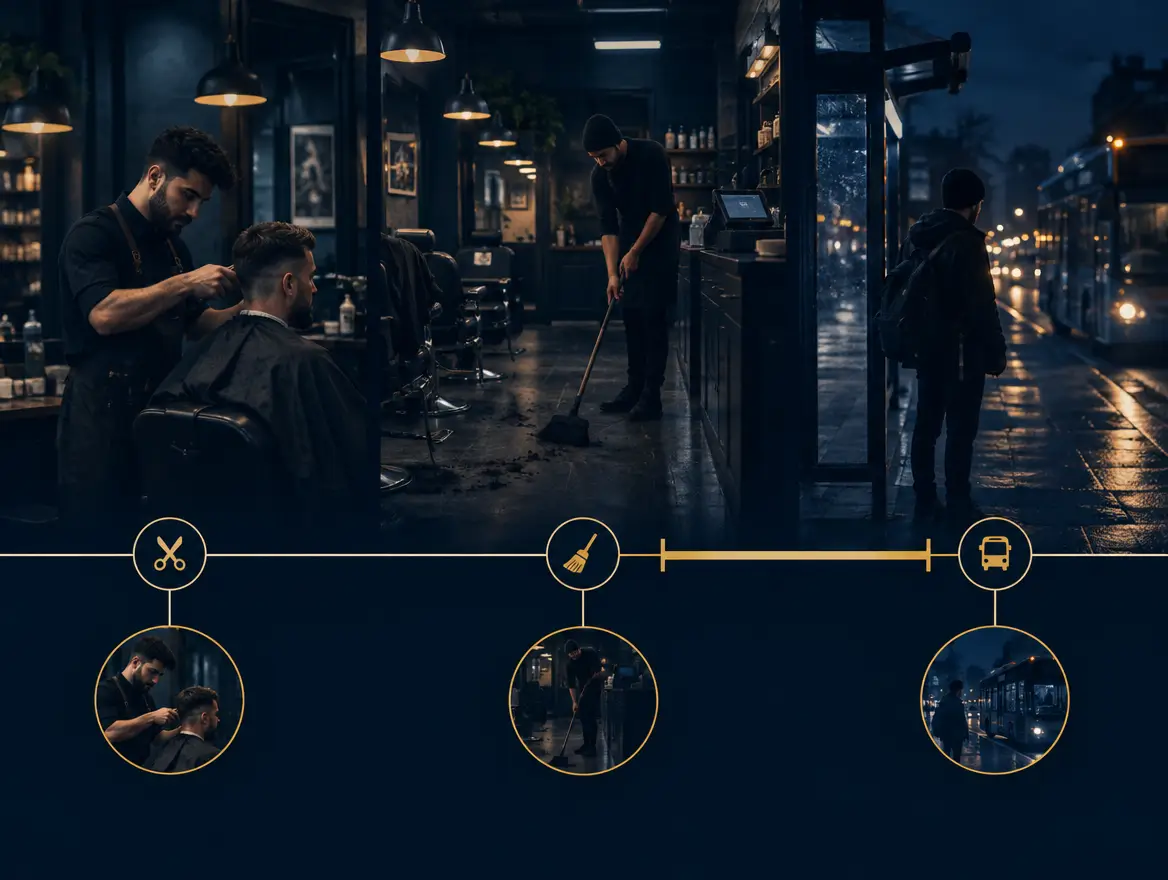
Here is the pattern to look for. A shop advertises a 7pm close. The last tidy-up finishes closer to half past. The last direct service leaves earlier than that. Now the barber is on a two-transfer trip or paying for a rideshare, and neither was in the ad.
The early end has the same problem. When I ran Black Sheep Barbershop on the Gold Coast, 6am opens were part of the job. A 6am open is a commute question before it is a roster question. If no service arrives early enough, goodwill will not fix it. Either the barber drives, rides or gets a lift, or the chair does not work.
What to do about a clash:
- Ask whether the roster can put you on earlier or later shifts so you avoid the gap.
- Ask whether staff share lifts or whether the shop has any arrangement for late finishes.
- Count the rideshare cost in your true cost, using current prices, not a guess.
- Consider whether the walk after dark is one you are comfortable doing weekly.
If you are an employee, check your award or agreement for conditions that apply to late and weekend work. The Fair Work Ombudsman publishes this information. If you are renting a chair, you may set more of your own hours, but the transport timetable does not move for you.
Working out the true cost of the commute
The true cost of a commute is fares or parking plus the unpaid hours spent travelling, set against the pay shown in the ad. Work it out per shift, then per week. Check current fares with your state transport authority rather than guessing, because fares and caps change.
Use this method for each chair you are comparing:
- Weekly travel cost. Daily fares or parking, multiplied by the shifts you would work. Add tolls, fuel or rideshare costs for shifts where public transport does not work.
- Weekly travel time. Door-to-door minutes each way, multiplied by two, multiplied by your shifts.
- Real weekly pay. The pay shown for the week, minus the travel cost.
- Real hours. Hours worked plus hours travelling.
- Real hourly rate. Real weekly pay divided by real hours.
Run that for each chair on your shortlist. A chair that pays a little less but sits ten minutes from home can beat a higher rate across town. It also leaves you energy for a second job, study or your own life.
Get fares from the source. Opal in Sydney, myki in Melbourne and go card in South East Queensland each work differently, and fare rules and caps are set by the state authority. Use the official fare calculator on the relevant authority's site and write the number down.
Two more notes. Travel between home and a regular workplace is generally treated as private travel by the ATO, so do not assume you can claim it. Check with the ATO or a registered tax agent for your situation. And for the bigger picture on rent, bills and what a wage really covers, see the separate guides on the cost of living for barbers and local barber salary data.
What shops should list in the ad
Shops should list the nearest station and stops, walking time from each, parking type and cost, last-service notes for late shifts, bike storage, and any staff arrangements such as a reserved bay or a lift home after close. Six lines in the ad answer most commute questions before a barber applies.
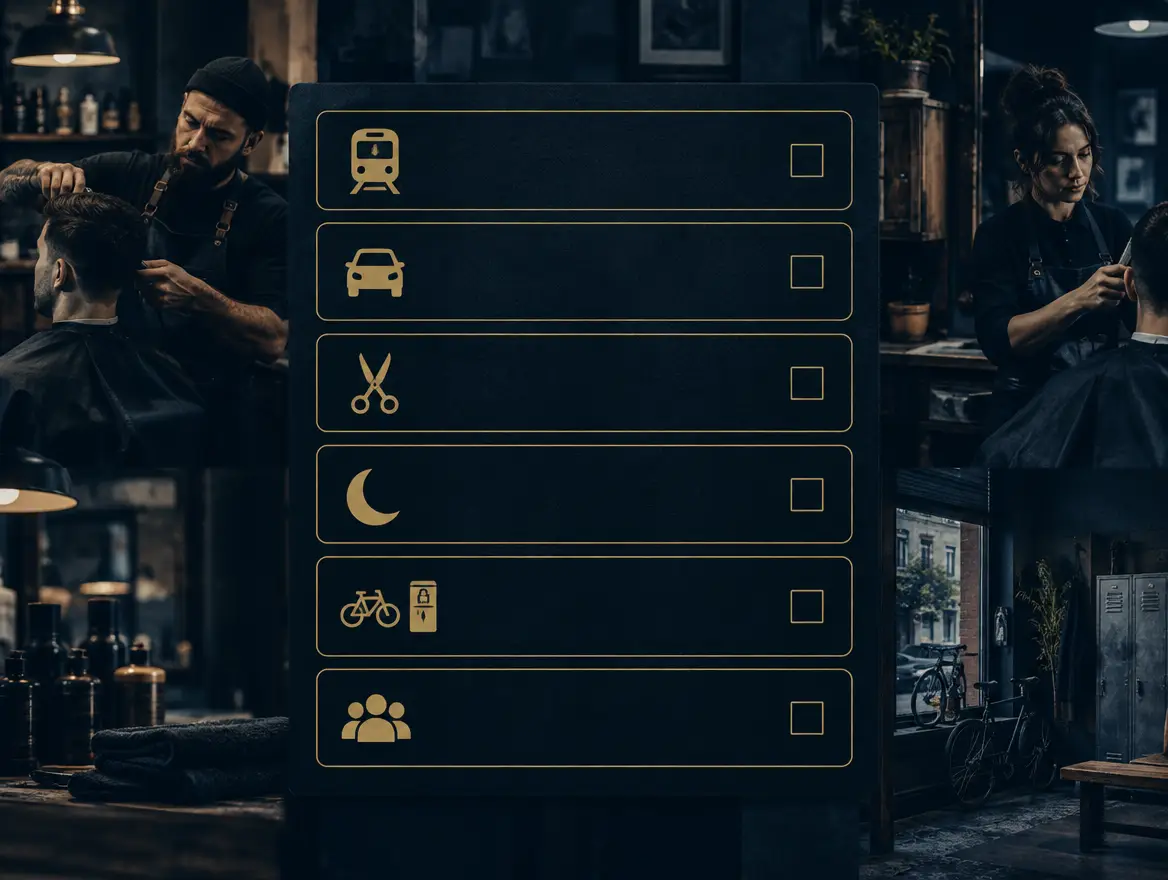
You already know the answers. You make the journey, or your staff do. Writing it down takes a few minutes and saves a lot of wasted trial shifts.
A simple commute checklist for your ad:
- Nearest station and stops: name them, and say how long the walk is.
- Parking: reserved, street, time-limited or paid, with the current cost.
- Opening shift: the first service that gets a barber in on time.
- Closing shift: the last service, and your typical real finish time.
- Bike and kit storage: where bikes lock up and where kit stays safe.
- Staff arrangements: reserved bay, shared lifts, a later start the morning after a late close, or none.
Be honest. If the late-night trip is hard, say so and say what you do about it. A barber who reads that and applies anyway is a barber who has already accepted the journey. That is a better applicant than one who finds out at the trial.
The detail also depends on the type of chair you are filling.
| Chair type | How commute affects it | What to state in the ad |
|---|---|---|
| Full-time | Repeated every week, so it drives retention | Full checklist, including late-close arrangements |
| Trial-to-perm | Barber needs to know the journey works before the trial | Station, parking and both shift ends |
| Rostered | Shifts vary, so timetables clash differently each day | Which shifts are early or late, and transport for each |
| Short cover | One-off, so tolerance is higher | Parking or nearest stop, and start time |
| Rent-a-chair | Barber sets some hours but still needs access | Parking, storage and the hours the shop is open |
Posting a role on BarberRise is free. The agency commission is 0%, never a percentage of wages, and the first placement is free for founding shops. Because roles go to barbers already screened for them, a clear commute section means the people who apply have already done the maths. Hire your way, and say how people get there.
Using commute details at the trial shift
Run the actual journey, at the actual hours, before you commit. Do it for the opening shift and the closing shift, on a day that matches your busiest roster day. A trial shift tests the chair. A trial commute tests whether you can keep it.
If you have a trial shift booked, treat the journey as part of the trial:
- Travel the way you would every week. Not the way you can manage once. If you plan to take the train, take the train.
- Leave when you would really leave. Use the shop's actual start time, not a time that suits you for the day.
- Time it door to door. Note the transfers, the waits and the walk.
- Do the trip home at the real finish time. Not an early knock-off because it is a trial.
- Note how you feel on arrival. If you are frazzled before the first cut, the chair costs you more than the rate suggests.
Then ask the shop three questions: whether the roster can flex around the journey, what staff do on late finishes, and whether parking or storage arrangements are fixed or change with the season. Good shops will have answers. The interview and trial advice on BarberRise covers more of what to ask on the day.
After the trial, run your real hourly rate again using what you actually spent and how long it actually took. If the number still works, you have a chair you can stay in.
The commute is a retention problem, not just a hiring problem
In ten years in the trade and three shops managed, I lost good barbers to bad commutes. They gave notice citing hours or energy. The real reason was a journey that ate their evenings, and it rarely appeared as the stated reason.
That is the part most hiring advice misses. Shops treat the commute as the barber's problem, solved or not solved before the first shift. In practice it is a retention cost, paid month after month. It looks like tiredness, lateness, a barber who stops picking up extra shifts, and eventually a resignation that seems to come from nowhere.
I also ran an academy inside my Canadian shops and trained barbers from scratch. Many were poached within months. That taught me that you cannot only invest in skill and hope people stay. The things that keep a barber in a chair are also practical: fair pay, a decent roster, a community, and a journey that does not wear them down. A full shop runs itself. An empty chair runs you.
My position is simple. A barber job ad that hides the commute is not saving the shop any trouble. It is moving the problem to the trial shift, or worse, to month three. Showing it up front screens out the mismatch early, from both sides of the chair. That is why I built BarberRise inside my own shop, for barbers and barbershops only, so details like this are part of the listing rather than something you chase through DMs and Facebook groups.
The long game matters too. A career behind the chair, not just a grind, needs a sustainable week. A journey that works in year one and breaks you by year five is a health and ergonomics issue, not a footnote.
Next steps: find your chair
Barbers: browse BarberRise roles with pay shown up front and check the commute before you apply. Use the checklist above, run the journey at the real hours, and work out your real hourly rate.
Shops: post your role free, add your transport and parking details, and pay 0% commission. Rise together starts with an ad that tells people what the job really involves.
References
- Transport for NSW, Trip planner, service information and fares
- Public Transport Victoria, Journey planner, timetables and myki fares
- TransLink Queensland, Journey planner, timetables and go card fares
- Fair Work Ombudsman, Pay, awards and workplace conditions information
- Australian Taxation Office, Work-related travel and deductions guidance
Frequently asked questions
What commute information should a barber job ad include?
A good ad names the nearest station and stops, parking type and cost, the first service for the opening shift and the last service for the closing shift, bike and kit storage, and any staff arrangements for late finishes. These details let barbers judge the chair before applying.
How far is too far to commute for a barber job?
There is no single distance. Work out your real hourly rate: weekly pay minus travel costs, divided by hours worked plus hours travelling. Compare that across chairs. Also consider how tired you will be, whether late finishes are safe, and whether the journey will still work in a year.
Can I claim my commute to a barbershop on tax?
Travel between home and a regular workplace is generally treated as private travel by the ATO, so you usually cannot claim it. Your situation may differ, especially if you work across locations. Check the ATO's guidance or speak to a registered tax agent.
How do I get home after a late barber shift if public transport stops?
Check the last service against your real finish time, which is later than closing. Options include asking for a roster that avoids the gap, sharing a lift with a colleague, driving, or budgeting for a rideshare. Count any regular rideshare cost in your true cost of the chair.
Should parking costs affect which barber job I take?
Yes. Parking is a recurring cost and can be a time problem too. Time-limited street parking is hard to manage on a full shift. Ask what is provided, check the signage and current prices yourself, and include the cost in your weekly comparison.
Find a chair near you
Every city, by state: barber jobs in Australia and hairdressing jobs in Australia. Pay floors and how each pay structure works: what barbers get paid.

BarberRise
The team building Australia's job platform for barbers and barbershops.
Keep reading

active local barber vacancies
Active Local Barber Vacancies in Australia: How to Find Live Chairs Near You and Keep Your Listing Current
17 min read

barber jobs by state
Barber and Hairdressing Jobs by State: How to Find the Right Chair Anywhere in Australia
18 min read

prominent local employers
Prominent Local Barbershop Employers in Australia: How to Spot the Shops Worth Working For in Your Suburb
16 min read