
A prominent local barbershop employer is a shop that barbers in the suburb already know as a good place to work. It hires because it is growing, not because people keep leaving. Its clients are loyal and its terms are clear. Ad spend is not on that list.
In most suburbs, a handful of barbershops do most of the local hiring. Working barbers know which ones they are. On a generic job board, though, "prominent" usually just means the biggest ad budget, and that tells you nothing about pay, culture or whether the chair is any good.
This guide redefines prominence around what barbers actually care about: steady hiring, pay shown up front, verified credentials on both sides and a clear chair type. You will get a framework for finding the strongest shops near you, a red-flag list, and a short playbook for owners who want to become the shop everyone wants to work for. It is about which employers are worth working for. Where shops are hiring is a separate question.
Key Takeaways
- Prominence is a track record: repeat hiring driven by growth, staff who stay, a loyal client base and clear terms.
- Chains, multi-site groups and independents each suit different barbers. Match the employer type to the stage of your career.
- You can research a local shop in an afternoon without applying: walk past at peak times, read booking and review pages, study the portfolio and ask working barbers.
- Hidden pay, vague commission terms and repeated unpaid trials are the three red flags that matter most.
- Owners win talent by posting pay up front, naming the chair type, verifying credentials and replying fast.
- Only barbers, only barbershops: a trade-specific platform surfaces good local employers that generic boards bury.
Built only for barbers and barbershops
Barbers: tell us where you want to cut and when, and shops see you first. Shops: post a role free, and your first placement is free as a founding shop.
Get startedSummary Table: Employer Types at a Glance
This table is qualitative. Every shop is different, so treat it as a starting point for your own research, not a rule.
| Employer type | What it typically offers | What to check | Often suits |
|---|---|---|---|
| Chain | Structure, set rosters, formal training, brand name on your CV | How pay is structured, how much say you get over your book | Apprentices and barbers returning to the trade |
| Multi-site group | Progression between sites, shared standards, more shift options | Whether promotion paths are real or just talked about | Barbers who want to move up to senior or manager roles |
| Independent | Autonomy, close mentoring, flexible chair terms, a strong local identity | Whether terms are written down and pay is listed | Experienced barbers and those building a personal following |
| Rent-a-chair arrangement | Your own clients and pricing, business freedom | Contractor status, insurance, who sets your hours | Established barbers with a loyal book |
What makes a barbershop a prominent local employer?
A prominent local employer is known by barbers for stable hiring, staff who stay, a strong client reputation and chair options stated plainly. The loudest ad is not the signal. Prominence is earned over months of consistent behaviour, and most of it is visible from the outside if you know where to look.
Repeat hiring that signals growth, not churn
A shop that hires often is not automatically a good employer. Hiring because a new chair opened is growth. Reposting the same chair every few weeks is churn. Look at the pattern: does the shop add chairs, extend trading hours or open a second site? Or does the same role keep reappearing?
The best employers hire in a way that tells a story. A barber leaves to open their own shop, the owner promotes from within, and a new junior chair opens up. That is a healthy shop.
Retention you can see from the outside
You do not need inside information to read retention. Check the shop's Instagram and booking page over time. If the same barbers appear in photos month after month, people are staying. If the team shifts every season, ask why. Long-serving staff are the cheapest and most honest advertising a shop can have.
Client reputation
Barbers go where the clients are. A shop with a loyal book, consistent reviews and a full diary gives a new barber a better chance of building their own clientele quickly. A shop with a quiet floor on a Saturday morning can promise whatever it likes. The chair will still be empty.
Chair options stated clearly
The strongest employers say what kind of chair they are offering. BarberRise supports five placement types, and a good listing names one of them:
- Full-time: a permanent role with a set weekly commitment.
- Trial-to-permanent: a defined, paid trial period with a clear review point and a path to a permanent role.
- Rostered: set shifts on a regular roster, useful for part-time barbers and those balancing other commitments.
- Short cover: fill-in work for leave, busy periods or a sudden gap.
- Rent-a-chair: you run your own business from a chair in the shop.
If a listing just says "barber wanted", you are being asked to guess. A prominent employer does not make you guess.
Chains, multi-site groups and independents: what does each offer?
Chains tend to offer structure, set hours and formal training. Multi-site groups often add progression between sites. Independents usually offer autonomy, closer mentoring and more flexible chair terms. None is automatically better. The right fit depends on whether you want a pathway, a pace or a say in how the shop runs.
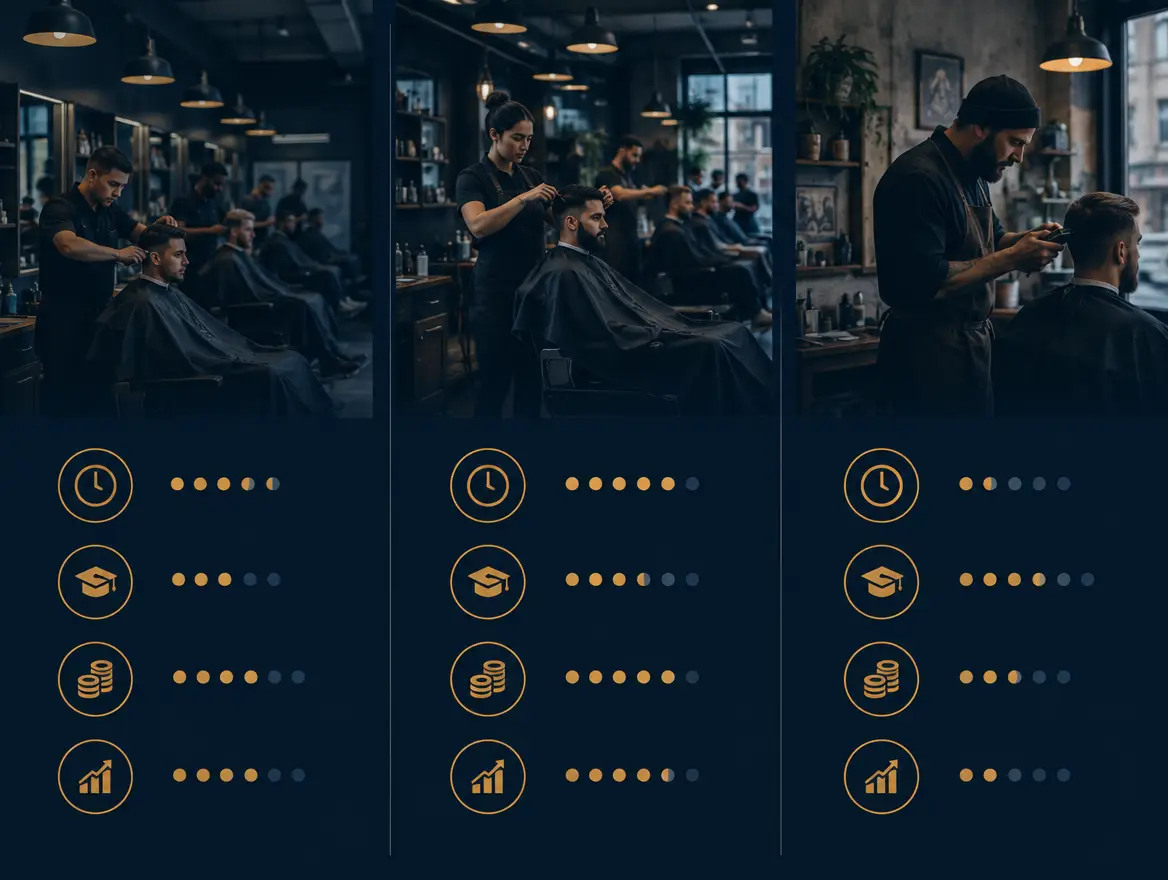
Chains
Chains usually run on systems. You can expect consistent standards, set rosters, a defined service menu and some form of in-house training. That suits apprentices and people returning to the trade, because the expectations are written down. The trade-off is often less freedom over pricing, product and how you build your book. Pay structure tends to be more standardised, so ask exactly how it works before you accept.
Multi-site groups
Groups with a few locations sit in the middle. They can offer movement between sites, a senior barber track and a chance to move into management without leaving the business. The question to ask is whether progression is real. Ask who held the senior role before and where they are now. A group that has promoted from within will have an answer straight away.
Independents
Independents are where a lot of the best mentoring happens, because the owner is often cutting hair beside you. Terms can be more flexible, including trial-to-permanent and rent-a-chair options. The risk is inconsistency. With no HR department, everything depends on the owner, so written terms matter even more.
Use these as tendencies, not guarantees. A well-run independent can beat a poorly run chain on every measure that matters to you.
How do you research barbershop employers in your suburb?
Start with what you can see without applying. Walk past at peak times, read booking and review pages, study the shop's Instagram portfolio, ask working barbers and check whether pay is listed. A shop that holds up on all five is worth a conversation. One that fails on pay transparency usually fails elsewhere.
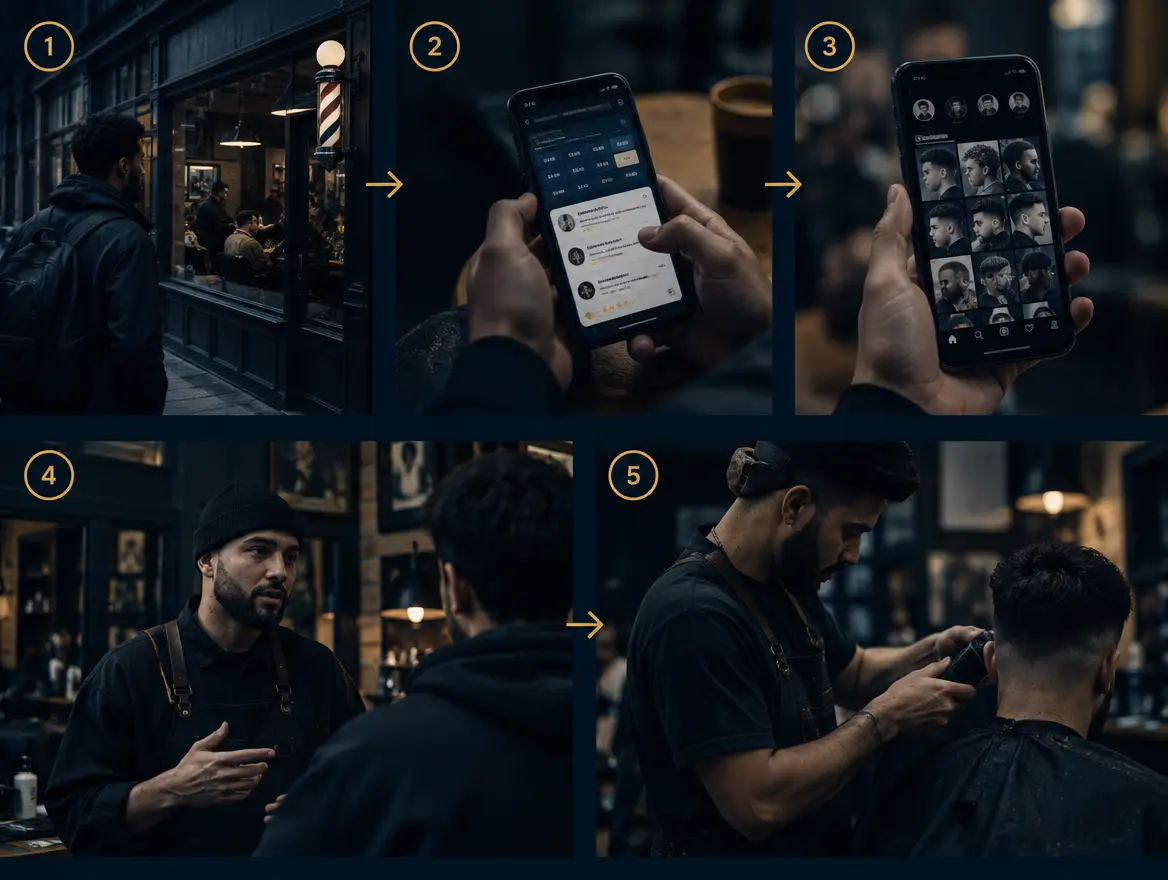
Five checks you can do in an afternoon
- Walk past at peak times. Saturday morning and weekday after-work hours show you whether the chairs are full, how the team works together and how clients are treated.
- Read the booking and review pages. Look at availability, service menu and how the shop responds to feedback. Owners who reply professionally to a bad review usually treat staff the same way.
- Study the Instagram portfolio. Does the work match the standard you want to cut at? Is it consistent across barbers, or only one person's work?
- Ask working barbers. Barbers talk. A quiet question to someone who cuts nearby, or to a barber who has worked there, is worth more than any careers page.
- Check whether pay is listed. If the shop will not tell you what the chair pays before you apply, treat that as information.
This is the stage where a nearby suburb is worth considering too. A shop two suburbs over with clear terms and a full diary can beat the one at the end of your street.
Red flags that matter most
Hidden pay. If a listing or conversation avoids the number, assume the number will not impress you. Pay shown up front is the simplest test of how a shop treats people.
Vague commission terms. "Competitive commission" is not a term. Ask what percentage applies, what it applies to, when it is paid and whether there is a guaranteed base. Get it in writing.
Repeated unpaid trials. A short, genuine skills check is one thing. A string of unpaid shifts that works as free labour is another. The Fair Work Ombudsman says unpaid work is only lawful in limited circumstances, so read its guidance before you agree to anything. Fades to Fair Work: if a trial turns into real work for the shop, it should be paid.
Also check which rules apply to the role. Many barbershop employees are covered by the Hairdressing and Beauty Services Award, though the right classification depends on your duties. If you are offered a rent-a-chair arrangement, be aware that contractor status depends on the real working relationship, not the label. The ATO publishes guidance on the difference between an employee and a contractor. If you are unsure, get independent advice before you sign.
Why do generic job boards bury the best local shops?
Generic boards bury the best local shops because a barbershop role sits among every other job in the city. Listings blur together, recruiters sit in the middle, and agency fees can come out of wages. We're not Seek. We're not Indeed. Only barbers, only barbershops.
The problem is structural. A general board is built to move every kind of job, so a chair-based barber role gets the same treatment as an office admin vacancy. The shop gets a pile of applications from people who have never held clippers. The barber scrolls past dozens of unrelated ads to find one relevant listing, and often no pay.
Then there is the middle layer. When a recruiter sits between the barber and the shop, someone has to be paid for that. Often the fee gets passed down in some form, whether through lower wages or a higher cost to the shop. Neither side sees the full picture of what the other wanted.
A board built for one trade works differently. Roles go straight to barbers already screened for them. Applications arrive with portfolio and experience attached. Shops can see barbers moving to their city before those barbers reach the open market. That is not a bigger ad. It is a better match.
How can shop owners become the employer barbers want?
Owners become the employer barbers want by doing four things well: post pay up front, state the chair type, verify credentials and reply fast. None costs money. All of them signal that the shop runs properly, which is exactly what a good barber is scanning for before they send a message.
Post pay up front
Barbers will not apply to a mystery number. Showing pay in the listing filters out mismatched applicants and attracts the right ones. It also tells the suburb that you have nothing to hide. If you are worried about competitors seeing your rates, remember that your staff already compare notes.
State the chair type
Say whether you are offering a full-time, trial-to-permanent, rostered, short cover or rent-a-chair placement. Barbers have different needs at different stages. A returning barber may want a rostered chair. An experienced cutter with a following may want to rent a chair. A shop that names the type gets applicants who want that exact arrangement.
Verify credentials, both ways
Check that a barber's qualifications and experience are what they say. Barbers deserve the same from you: a real business, real terms and a real workplace. On BarberRise, credentials are checked before a profile shows as verified, so trust is built on both sides of the chair.
Reply quickly
A good barber has options. If your reply takes a week, someone else's takes a day. Fast, clear responses, including a polite no, build the kind of reputation that makes the next hire easier. A full shop runs itself. An empty chair runs you.
Keep the people you hire
Hiring well is only half of it. Barbers stay where they can see a path: training, a growing book, fair pay and a team they like. If your shop cannot show a clear next step for a barber, expect the best ones to look elsewhere.
Finding or becoming a standout local employer on BarberRise
On BarberRise, barbers browse verified local chairs with pay shown up front, and shops post roles free with 0% commission. Five placement types are supported: full-time, trial-to-permanent, rostered, short cover and rent-a-chair. Standout employers show up through clear listings and fast replies, not ad budget.
The process is three steps. Both sides.
- Create your profile. Barbers add portfolio, experience and the chair types they want. Shops add the business, the culture and the roles.
- Post or browse. Shops post a role free. Barbers browse verified local chairs, with pay shown up front.
- Connect and work. Both sides choose the kind of chair that suits them, then get to work.
Barbers from the UK, Canada and New Zealand can tell shops where they are heading and when, months before they land. The Australia Ready pass helps them prepare to cut here. BarberRise never gives visa advice. Visa questions always go to a registered migration agent.
There is also more to the platform than placement. BarberRise runs on three tiers: community, education and job placement. Skills get you started. A community gets you further. That matters because a career behind the chair, not just a grind, needs more than a job. It needs practical education, healthy work habits and people to learn from.
Posting a role is free. The agency commission is 0%, never a percentage of wages. The first placement is free for founding shops.
If you are a barber: browse verified local chairs with pay shown up front and find your chair.
If you own a shop: post a role free, with 0% commission. Founding shops get their first placement free.
Why the same shops always fill their chairs
In BarberRise founder Justin's view, the shops that always fill their chairs are not the ones with the best ad. They are the ones barbers already know and trust. That reputation comes from ordinary things done consistently: clear pay, honest terms, a path forward and an owner who shows up.
Justin has ten years in the trade and has managed three shops. In that time he saw the same pattern again and again. Some shops struggled to hire every time a chair opened. Others rarely had to. The difference was not budget. It was whether barbers wanted to be there.
He also learned a hard lesson about training. In his Canadian shops, Justin ran an academy inside the business and trained barbers from scratch. He put real effort into developing new staff. Within months, many of those barbers were poached. The economics were brutal: the shop paid for the training and a competitor got the result. That experience shaped how he thinks about hiring and retention. Training without a reason to stay is a gift to the shop down the road.
Later, as the owner of Black Sheep Barbershop on the Gold Coast, he lived the other side of it: 6am opens, no-shows, staff hunts and the near impossibility of stepping away from the chair while keeping every chair filled. He built BarberRise inside his own shop so that shops could hire from barbers already screened for the chair, instead of hunting through Facebook groups, DMs and generic job boards.
The contrarian takeaway is this. Most advice tells shops to advertise harder. We think they should be easier to trust. Make pay visible, name the chair, verify both sides and reply fast. Do that for long enough and you stop chasing candidates. Barbers start finding you. Rise together.
References
- Fair Work Ombudsman, Unpaid work
- Fair Work Ombudsman, Hairdressing and Beauty Services Award summary
- Australian Taxation Office, Employee or contractor
Frequently asked questions
What makes a barbershop a good employer?
A good barbershop employer shows pay up front, names the chair type, puts commission terms in writing and keeps its staff. Clients are loyal, the diary is full and the owner replies promptly. If a shop is vague about pay or terms, that is usually a sign of how it will treat you once you start.
How do I find the best barbershops to work for near me?
Walk past local shops at peak times, read their booking and review pages, study their Instagram portfolios and ask working barbers. Then check whether pay is listed. You can also browse verified local chairs on a barber-only platform, where pay is shown up front and roles are matched to barbers screened for them.
Is it normal to do an unpaid trial at a barbershop?
A short, genuine skills check can be reasonable, but repeated or lengthy unpaid trials are a red flag. The Fair Work Ombudsman says unpaid work is only lawful in limited circumstances. If a trial turns into productive work for the shop, ask for it to be paid, and check the Fair Work guidance first.
What is the difference between trial-to-permanent and rent-a-chair?
Trial-to-permanent is an employment path: a defined trial with a review point and, if it works, a permanent role. Rent-a-chair means you run your own business from a chair in the shop, with your own clients. Whether either arrangement is genuine depends on the real working relationship, so get terms in writing.
Does BarberRise charge barbers or shops?
Posting a role on BarberRise is free. The agency commission is 0%, never a percentage of wages. The first placement is free for founding shops. Barbers browse verified local chairs with pay shown up front.
Find a chair near you
Every city, by state: barber jobs in Australia and hairdressing jobs in Australia. Pay floors and how each pay structure works: what barbers get paid.

BarberRise
The team building Australia's job platform for barbers and barbershops.
Keep reading
barber job market FAQs
Barber Job Market FAQs: Straight Answers About Finding or Filling a Chair in Your City
15 min read

suburb-level salary data
Suburb-Level Salary Data for Barbers in Australia: Why Pay Changes Street by Street and How to Use It
19 min read

local commute information
Local Commute Information for Barber Jobs in Australia: What Barbers Should Check and What Shops Should Include in the Ad
16 min read