
The fastest way to find apprentice barber jobs by city is to search a board built only for barbers, start with your city or regional hub, filter by work type and pay shown up front, then set a job alert. Before accepting, check training hours, who supervises you and current apprentice award rates with Fair Work.
Getting your first chair is the hardest step in a barbering career. General job boards bury apprentice roles under salon, retail and unrelated listings, and most ads tell you nothing about the training on offer. You end up applying blind.
This guide shows how to search city by city on a barber-only board, what a good training chair looks like, and what to ask before you say yes. It finishes with a section for shop owners who want to take on an apprentice. It sits alongside our pieces on qualifications, pay structures and relocating, so we stay on the apprentice stage here.
Key Takeaways
- General boards mix barber apprenticeships with hairdressing, salon and retail roles, so you sift for hours and still miss what training a shop offers.
- A barber-only board lets you search by city or region, filter by placement type and see pay up front.
- A good training chair has a named mentor, a clear skill progression and a stated path from trial to permanent.
- Ask about training hours, supervision and formal training support before accepting, and check current apprentice award rates with Fair Work rather than relying on an ad.
- With little experience, a complete profile, a portfolio of practice work and a clear goal still beat a blank CV.
- Shops can post an apprentice role for free, with 0% agency commission, never a percentage of wages.
Built only for barbers and barbershops
Barbers: tell us where you want to cut and when, and shops see you first. Shops: post a role free, and your first placement is free as a founding shop.
Get startedSummary Table
| Step | What to do | What you get out of it |
|---|---|---|
| Search | Pick your city or regional hub on a barber-only board | Roles written for barbers, not mixed with salon or retail ads |
| Filter | Choose work type and check pay shown up front | A shortlist of chairs that suit your situation |
| Alerts | Set a job alert for your city | New apprentice and junior roles reach you early |
| Assess | Check mentoring, progression and the trial-to-permanent path | A shop that wants to keep you, not just fill a gap |
| Ask | Raise training hours, supervision and formal training support | Fewer surprises after you start |
| Verify | Confirm current apprentice rates with Fair Work | Pay you can rely on |
| Apply | Build a profile with a portfolio and a clear goal | A stronger application with little experience |
Why Apprentice Roles Are Hard to Find on General Job Boards
Apprentice barber roles are hard to find on general boards because those boards are built for every industry at once. Barber listings share space with hairdressing, beauty, retail and hospitality ads, and few ads describe the training. You can't easily tell a real learning chair from a cheap pair of hands.
The search results on big general boards show the problem. A search for apprentice barber jobs returns a mix of hairdressing apprenticeships, salon assistant roles and the occasional barbershop. Filters such as salary type, work type, remote option, classification and date listed are built to cover every trade. They are not built for a trade where the unit of work is a chair.
Here is what that costs a school leaver or career changer:
- Wasted time. You open listings that turn out to be for ladies' hairdressing or front-of-house work.
- No training detail. Most ads list a title and a suburb. They rarely say who teaches you, how often, or what you will be cutting in month three.
- Hidden pay. Many ads say nothing about rates, so you only learn the offer after you have applied.
- Wrong fit. A barbershop apprenticeship and a hairdressing apprenticeship are not the same job, even when the board files them under the same classification.
We're not Seek. We're not Indeed. We're only for barbers and barbershops. That is the whole point of a barber-only board. Every role is a chair, every shop is a barbershop, and the placement type is stated, whether that is full-time, trial-to-permanent, rostered, short cover or rent-a-chair. Only barbers, only barbershops.
How to Run an Apprentice Barber Job Search on a Barber-Only Board
Searching a barber-only board takes four moves: choose your city, filter by placement type, read the pay and training detail shown up front, then set an alert. This replaces the scroll-and-guess method of general boards with a short, relevant list you can actually act on.
Start with your city or region
Barbering is local work. You cannot cut hair remotely, so there is no point in a remote filter. Start with the place you can reach for a 6am open, by train, car or bike. If you are searching for apprentice barber jobs near me, begin with your nearest city hub, then widen to neighbouring suburbs and regional towns if nothing fits.
Filter by placement type
Placement type tells you how the chair works before you read a word of the ad. For an apprentice, the most relevant types are:
- Full-time: a standard role with regular hours.
- Trial-to-permanent: a short trial that can lead to an ongoing role. This is a common and sensible way for a shop and a first-year apprentice to test the fit.
- Rostered: set shifts around the shop's busy periods, often useful if you are studying or working another job.
- Short cover: fill-in work. Handy for experience, less so for structured training.
- Rent-a-chair: you rent a chair and run your own book. This is rarely right for a true apprentice, because you need supervision and paid learning time first.
Read the pay shown up front
Salary type matters more for apprentices than for anyone else, because rates are tied to awards and training contracts. A barber-only board shows pay up front, so you can compare shops fairly. Do not treat any figure in an ad as the final word. Check current apprentice award rates with Fair Work, which we cover in the questions section below.
Check the classification
Classification is where general boards trip people up. Look for roles clearly labelled for barbering. If an ad says hairdressing apprenticeship, read the detail to see whether the shop does barbering work such as fades, clipper work, beard trims and razor finishes. If you want barbering, say so in your application and ask the shop to confirm what you would be trained in.
Use date listed and alerts
Good training chairs fill quickly. Date listed tells you whether a role is fresh or stale. A better habit is to set up Barber Job Alerts for your city, so new apprentice and junior roles come to you instead of you checking daily. Alerts also help you apply early, which matters when a shop wants someone started before a busy season.
Using City and Region Hubs to See Where Apprentice Roles Are Listed
City and region hubs group barber roles by location, so you can see where apprentice and junior roles are listed without sifting national results. Start with the capital city nearest you, then check surrounding regions. Each hub gives you a local read on the market before you apply.
We publish hubs for Australian cities and regions as part of the wider Barber Jobs in Australia hub. The logic is simple. A search for apprentice barber jobs in Sydney is a different job from a search in Hobart or Townsville. Shop density, rent, foot traffic and training culture all differ.
Capital cities
Sydney, Melbourne, Brisbane, Perth and Adelaide have the most barbershops, so they have the most chairs and the widest choice of shop styles. That choice cuts both ways. You can find a classic cut-throat shop, a fade-focused street shop or a high-volume chain-style operation. You also compete with more applicants. Use alerts and a strong profile to stay ahead.
Gold Coast, Canberra and other large centres
Mid-sized cities often have busy shops and fewer applicants per role. Many have tight-knit scenes where reputation travels fast. A shop that trains well in a mid-sized city often becomes known for it, which helps your CV for years.
Regional towns
Regional shops may list fewer roles, but they often need apprentices because the local pool of barbers is small. You may get more one-on-one time with a senior barber and a wider range of clients, from school cuts to older gents. The trade-off is that you may need your own transport and flexibility on hours. If you are open to moving, our City Career Guides cover what each place offers, and our piece on relocating interstate covers the move itself.
A practical way to use hubs: open your home city, then the two nearest regions. Note which shops list apprentice or junior roles, then read the training detail on each. Even if a role is not open, a shop that has hired apprentices before is worth a profile follow-up.
What a Good Training Chair Looks Like
A good training chair has four things: a named mentor, a structured skill progression, pay shown up front and a clear path from trial to permanent. If a shop cannot explain all four, you are probably being hired to sweep floors and take overflow, not to learn the trade.
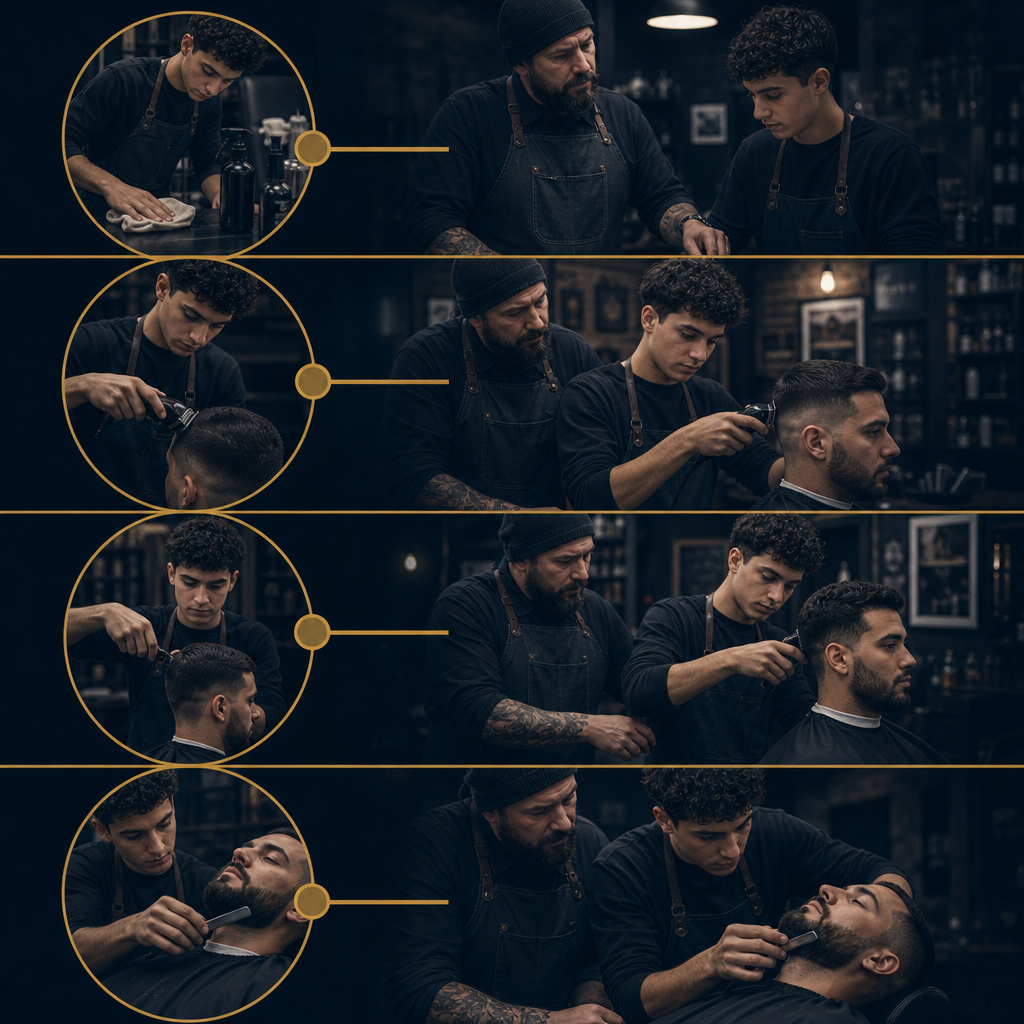
A named mentor
You need one senior barber who is responsible for your development. Not "everyone helps out", but a specific person with time set aside to watch your work and correct it. Ask who that is, and meet them before you accept.
Structured skill progression
A good shop can describe your first six months in plain terms. For example, shop basics and hygiene first, then clipper-over-comb and basic tapers, then fades on practice heads and willing models, then supervised paying clients, then beard work and razor finishes. The exact order varies. The point is that there is an order.
Be wary of a shop that puts you on the floor with paying clients in week one without supervision. Equally, be wary of a shop where you sweep for months and never touch a clipper.
Pay shown up front
Pay that is stated clearly in the ad signals a shop that respects your time. If an ad hides the rate, ask early. You are entitled to understand what you will earn, and you should confirm it against current award rates. Our Barber Commission and Benefits Explained article covers how commission and benefits work once you are qualified.
A clear path from trial to permanent
Many shops use a trial period. That is fair. What matters is that the shop tells you what happens at the end of it: what they are looking for, when you will be reviewed, and what an ongoing role looks like. A trial with no stated outcome is a free try-out, not a pathway.
Questions to Ask a Shop Before You Say Yes
Before accepting an apprenticeship, ask about training hours, who supervises you, how formal training is supported and what happens at the end of the trial. Then check current apprentice award rates with Fair Work. A good shop answers these questions easily and without defensiveness.
Training hours
- How many hours a week will I spend on the floor, and how many on structured learning?
- Is time set aside for practice on models or mannequins, or do I only learn on paying clients?
- Will I be rostered for busy periods only, or across the week so I see different work?
Supervision
- Who supervises me when I cut a paying client?
- Is that person in the shop for all of my shifts?
- How is my work reviewed, and how often?
Formal training support
Most Australian apprenticeships combine on-the-job learning with a nationally recognised qualification, usually through a registered training organisation. The formal side is set out in a training contract. Ask:
- Which registered training organisation will I study with?
- Does the shop give me time for study and assessments?
- Who handles the paperwork, and how do the shop and the training provider communicate?
The Australian Apprenticeships website and the national register at training.gov.au explain how apprenticeships and qualifications work. Our Barber Qualifications and Experience Requirements article goes deeper on what you need and when.
Pay and conditions: from fades to Fair Work
Fades to Fair Work: once the cut is done, the conditions have to stand up too. Apprentice rates are set by the relevant award and your training contract, and they change over time. We do not quote figures here because any number we print could be out of date by the time you read it. Use the Fair Work Ombudsman's pay tools to check your current apprentice rate, and confirm which award applies to the shop.
Ask the shop to put the following in writing:
- Your hourly rate and how it changes as you progress.
- Your hours and rostering.
- Whether you pay for tools, uniforms or training costs.
- What happens at the end of the trial period.
If a shop is vague about any of these, treat that as information. You are choosing a place to spend years learning your craft.
Building a Profile That Stands Out With Little Experience
With little experience, stand out by completing your profile fully, showing practice work in a portfolio and stating clearly what you want to learn. Shops hiring apprentices are not looking for a finished barber. They are looking for reliability, attitude and evidence that you have started.
This is step one of Three steps. Both sides: create your profile, post or browse, connect and work. Here is how to make step one count.
What to include
- Clear photos of your work. Practice cuts on mannequins or friends are fine. Show clean lines and consistent finishing.
- A short statement of intent. Say why barbering, what styles interest you and what you want from a training chair.
- Availability. Be specific about days, hours and transport.
- Any related experience. Customer service, hospitality, retail or sport. These show you can turn up, work with people and take instruction.
- Your preferred placement type. Trial-to-permanent signals you want to build something.
How verified credentials grow
You do not need a long list of credentials on day one. On BarberRise, credentials are checked before a profile shows as verified. As your training progresses, you add what you complete, such as qualification milestones and work history, and your profile carries more weight with shops. Treat your profile as a record that grows with you, so each year in the trade makes the next application easier.
Skills get you started. A community gets you further.
A good profile gets you the first conversation. What keeps you in the trade is learning from others. Join the conversation with other barbers, follow shops you admire and ask questions. Our education content covers the practical side as well: ergonomics, looking after your body and building a client base. That is education that outlasts hustle culture, and it matters from your first week.
For Shop Owners: Posting an Apprentice Role and Reaching Barbers Who Want to Learn
Shop owners can post an apprentice role on BarberRise for free, with 0% agency commission and never a percentage of wages. The first placement is free for founding shops. Your role reaches barbers who want the trade, with portfolio and experience attached to each application.
A full shop runs itself. An empty chair runs you. If you have an unfilled chair and no time to train someone, the temptation is to post on a general board and hope. The result is a pile of unscreened applications and hours of sifting.
Here is how a barber-only approach differs:
- The role goes to barbers already screened for it. You are not sifting retail and hairdressing applicants.
- Applications arrive with portfolio and experience attached. You see work before you call.
- You choose your placement type. Full-time, trial-to-permanent, rostered, short cover or rent-a-chair. Hire your way.
- There is no commission. Posting is free, and we never take a percentage of wages.
Write an apprentice ad that attracts the right people
The best apprentice ads say what the training involves. Include your mentor's name or role, the structure of the first months, the pay or pay basis, and what happens after a trial. Apprentices read ads for evidence you will teach them. If you show it, you stand out from every general board listing around you.
Be honest about what you need too. If you need someone who can start on Saturdays and handle a 6am open, say so. Clarity filters for people who will actually stay.
Shops can also see barbers moving to their city before those barbers reach the open market. For an apprentice search, that is mostly relevant to career changers relocating within Australia, but it shows how the platform works for both sides of the chair.
Post an apprentice role for free and start building the next generation of your shop.
Why Training Economics Shape Who You Should Work For
Training a barber from scratch only pays back if the shop builds a reason for them to stay. BarberRise founder Justin has ten years in the trade and has managed three shops. That experience shapes how we think about apprentices on both sides of the chair.
In his Canadian shops, Justin ran an academy inside the business and trained barbers from scratch. He invested in developing new staff. Within months, some of those staff were poached. The economics of training people who then walked out the door shaped his view of what barbershops need from recruitment and retention.
Later, as owner of Black Sheep Barbershop on the Gold Coast, he lived the other side of the problem: 6am opens, no-shows, hunting for staff on Facebook groups and DMs, and no way to step away from the chair without a gap in the roster. He built BarberRise inside his own shop so shops could hire from barbers already screened for the chair.
Here is what that means for an apprentice choosing a shop. Our position is that the best training chairs are not the ones that promise the most. They are the ones that have thought about what happens after training. A shop that has worked out its retention story will tell you:
- how your pay and responsibility grow,
- when a trial becomes an ongoing role, and
- what the shop does to make staying worthwhile.
A shop that has never thought about this is likely to treat apprentices as disposable, or to lose them as soon as someone else offers more. Neither is good for you.
So when you interview, ask the owner what happened to their last apprentice. A good answer is specific and honest. A vague answer, or a complaint about how nobody wants to work, tells you what you need to know. That is a career behind the chair, not just a grind, and it starts with choosing a shop that wants to keep you.
Ready to start? Create a free profile, set job alerts for your city and find your chair. Rise together.
References
- Fair Work Ombudsman, Pay, awards and apprentice information
- Australian Government, Australian Apprenticeships
- Australian Government, National register of vocational education and training (training.gov.au)
Frequently asked questions
How do I become a barber apprentice in Australia?
You find a barbershop willing to employ and train you, then sign a training contract linked to a nationally recognised qualification through a registered training organisation. Start by building a profile, searching your city on a barber-only board and checking the process on the Australian Apprenticeships website.
How do I find apprentice barber jobs near me?
Open your nearest city or regional hub on a barber-only board, filter by placement type, and set a job alert so new roles reach you. Widen your search to neighbouring suburbs and regional towns if nothing suits. Ask shops you like whether they take apprentices, even if no role is listed.
Do barbershops hire apprentices with no experience?
Yes. Shops hiring apprentices expect you to be new. They look for reliability, a willingness to learn and some sign you have started, such as practice cuts in a portfolio. Related experience in customer service or hospitality also helps.
How much does an apprentice barber get paid?
Apprentice pay depends on the relevant award, your training contract and your stage of training, and rates change over time. Check current apprentice rates with the Fair Work Ombudsman and ask the shop to put your rate and hours in writing before you accept.
Is it free for a barbershop to post an apprentice role?
Yes. Posting a role on BarberRise is free, there is 0% agency commission and never a percentage of wages, and the first placement is free for founding shops.
Find a chair near you
Every city, by state: barber jobs in Australia and hairdressing jobs in Australia. Pay floors and how each pay structure works: what barbers get paid.

BarberRise
The team building Australia's job platform for barbers and barbershops.
Keep reading

Barber and hairdressing jobs in Australia
Barber and Hairdressing Jobs in Australia: Where to Find Them and How to Land the Right Chair
15 min read

barber jobs nearby locations
Barber Jobs in Nearby Locations: How to Widen Your Search to Surrounding Suburbs and Towns Without Losing the Right Chair
16 min read

local salary benchmarks
Local Salary Benchmarks for Barbers: How to Compare Pay Across Australian Cities and Regions
16 min read