Hairdressing jobs by state in Australia are best searched state first, then city. NSW, VIC and QLD have the largest metro markets, while WA, SA, TAS, the ACT and NT offer smaller, more concentrated pools. For hairdressers moving into barbering, a state view lets you match lifestyle, award pay and chair type before narrowing to a suburb.
Most job searches start with a suburb and a keyword. That works if you already know where you are living. It fails when you are weighing a move from Newcastle to Melbourne, or from a regional salon to a Gold Coast barbershop. Pick the wrong state and you spend months chasing chairs in a market that does not suit your life.
This piece sits one level above our city-by-city hairdressing jobs hub. It covers how the states differ, how your salon skills carry over to clipper work, what the Hair and Beauty Industry Award means for pay, which chair arrangements exist, and how shops can write a listing that reaches retraining hairdressers. Every pointer here leads to barbershop chairs, not general salon work. Only barbers, only barbershops.
Key Takeaways
- Choose your state before your city. Lifestyle, rent, family and regional access shape a barbering career more than a single job ad.
- NSW, VIC and QLD have the biggest metro markets. WA, SA, TAS, the ACT and NT are smaller, and regional pockets in every state often have unfilled chairs.
- Scissor skills transfer, but shops test fades, clipper control and beard work at the trade test. Practise those before you apply.
- The Hair and Beauty Industry Award applies nationally and sets a minimum, not the market rate. Check pay shown up front, and treat rent-a-chair as a different deal from employment.
- Shops that name the chair type, show pay and say they welcome retraining hairdressers reach a wider pool, in any state.
Built only for barbers and barbershops
Barbers: tell us where you want to cut and when, and shops see you first. Shops: post a role free, and your first placement is free as a founding shop.
Get startedSummary Table: The Eight Markets at a Glance
This table is our qualitative read of each market. It contains no vacancy counts. Live roles change daily, so check the board for current chairs.
| State or territory | Main metro hubs | Regional pockets | Best suited to |
|---|---|---|---|
| NSW | Sydney, Newcastle, Wollongong | Central Coast, Hunter, Illawarra, Central West, Northern Rivers | Hairdressers wanting the widest range of shop styles |
| VIC | Melbourne, Geelong | Ballarat, Bendigo, Gippsland | Those who want a strong barbering culture and variety |
| QLD | Brisbane, Gold Coast, Sunshine Coast | Townsville, Cairns, Toowoomba | Hairdressers wanting lifestyle and a growing market |
| WA | Perth, Fremantle | Mandurah, Bunbury, Kalgoorlie | Those open to a more isolated, self-contained market |
| SA | Adelaide | Mount Gambier, Barossa, Riverland | Hairdressers wanting a lower-pressure metro |
| TAS | Hobart, Launceston | Devonport, Burnie | Those who want a small-town feel with a clear local name |
| ACT | Canberra | Queanbeyan across the border | Hairdressers wanting steady, professional-area clientele |
| NT | Darwin | Alice Springs, Katherine | Adventurous cutters open to remote work |
Why Does a State View Come Before a City Search?
A state view comes first because the state decides your cost of living, your travel distances, your award and employment context, and your career options. A city search assumes you have already chosen where to live. Most hairdressers moving into barbering have not, and the choice matters more than the first job.
Regional spread changes the picture
Every state has a capital that dominates, then a scatter of regional centres. The capital has the most shops and the most competition for chairs. The regional centres often have fewer shops, and a shop that loses one barber feels it immediately. That can mean more willingness to train a hairdresser who is keen. If you are happy to live outside a capital, a state view shows you the whole map, not just the biggest dot.
Which state do you actually want to live in?
This is the question job boards skip. A chair in a city you cannot afford is not a good chair. Before you apply anywhere, run the numbers on rent, commute and what a week of cuts has to cover. Our cost of living for barbers guide and our suburb-level salary data for barbers are the two resources to read next. They show how pay and living costs interact across places.
Moving between states
Interstate moves are common in this trade. Your hairdressing qualification is nationally recognised, so you do not start again when you cross a border. What changes is your client base. You arrive with none, and a new shop's walk-in traffic and booking system carry you in the first months. If you are coming from overseas, that is a different path: BarberRise never gives visa advice, and visa questions always go to a registered migration agent.
State-by-State Snapshot
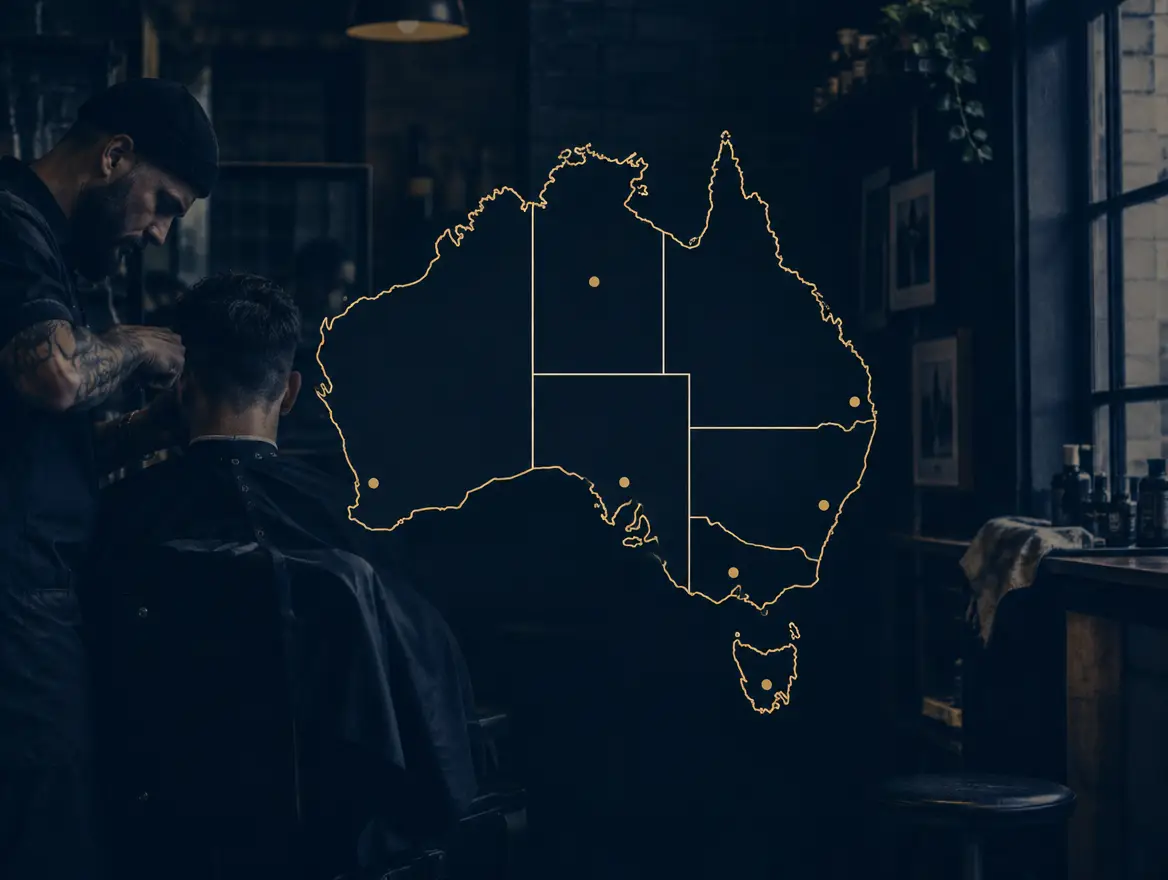
Each state and territory has its own mix of metro hubs and regional pockets. NSW, VIC and QLD have the largest populations and the most shops. WA, SA, TAS, the ACT and NT are smaller, with their own character. Use the paragraphs below to shortlist two states, then move to the city pages.
New South Wales
Sydney is the obvious hub, with shop styles ranging from classic to high-fashion. Newcastle and Wollongong have their own established scenes, and the Central Coast, Hunter and Illawarra give you coastal living within reach of a metro. Further out, Northern Rivers and the Central West have smaller pools. To go deeper, use the NSW pages in our city-by-city hairdressing jobs hub.
Victoria
Melbourne has a strong barbering culture and a lot of independent shops, which means plenty of chair styles to choose from. Geelong sits close enough for many to commute or relocate cheaply. Ballarat, Bendigo and Gippsland are the regional options. Hairdressers who like an owner-led, craft-first shop often look at Victoria first.
Queensland
Brisbane, the Gold Coast and the Sunshine Coast make up the south-east corner, which is where most of the volume sits. Our founder ran Black Sheep Barbershop on the Gold Coast, so we know that corner well: early opens, a busy walk-in trade and shops that need every chair filled. Townsville, Cairns and Toowoomba are the regional anchors.
Western Australia
Perth and Fremantle are the core. WA is geographically isolated, so the local market tends to hire locally or from overseas more than from the east. Mandurah and Bunbury offer coastal regional options, and Kalgoorlie and the Pilbara suit those open to remote work. Interstate hairdressers should plan the move carefully, because distances are long and returning is expensive.
South Australia
Adelaide is a compact capital with an established independent shop scene. If you want metro work without the pressure of a larger city, it deserves a look. Mount Gambier, the Barossa and the Riverland give you regional pockets where a retraining hairdresser can become the shop's anchor.
Tasmania
Hobart and Launceston are the two main hubs, with Devonport and Burnie on the north-west coast. Tasmania is a small market where reputation travels quickly. That cuts both ways: a good name builds fast, and a bad one does too. It suits hairdressers who want to be known in a community.
Australian Capital Territory
Canberra is a single-city market with a steady professional clientele, and many people also cross from Queanbeyan in NSW. If you are open to either side of the border, search both. The ACT suits hairdressers who want regular clients and predictable rhythms.
Northern Territory
Darwin is the main hub, with Alice Springs and Katherine as remote options. It is the smallest market on the list, and a transient one. For the right person, that means opportunity and a very different lifestyle. For others, it is a stretch. Be honest with yourself before you go.
How Do You Search and Refine a State View?
Start broad with the state, then refine by chair type, pay, location and how recent the listing is. A good search narrows quickly without hiding useful roles. The filters below match the ones you will see on generic boards, with a barbershop lens on what each one is worth.
Perform a state search, then refine it
On a general board, searching "hairdresser" returns salons, mobile services, beauty therapists and everything between. You sift all of it. On a board built for one trade, the state search already shows only barbershop chairs, so refining is about fit, not filtering out noise.
Salary type and work type
Salary type tells you whether pay is an hourly rate, a salary, a commission split or a chair rental fee. Work type tells you whether it is full-time, part-time or casual. In barbering, both matter more than on a generic board, because the same chair can be paid very differently. Pay should be shown up front. If a listing hides it, ask why.
Classification
On Seek or Indeed, classification puts a role under a broad category such as hair and beauty. That category lumps barbers with colourists, nail technicians and beauty therapists. For you, a better classification is the one the shop describes: fades, skin fades, beard work, kids, walk-in or booked-only. Read the description for those words.
Date listed
A recent listing is a live chair. An old listing may be filled, or may be a shop that has quietly given up on the board. Sort by newest, and apply early. In a trade where a full shop runs itself and an empty chair runs you, shops move fast once someone is a fit.
Remote option
Generic boards offer a remote filter. For chair work it does not apply, because you cannot cut a fade over Zoom. The nearest equivalent is flexibility: rostered days, short cover and rent-a-chair let you work around other commitments, and we cover those below.
Moving Your Skills From Salon to Barbershop
Hairdressers bring scissor technique, consultation skills and client care, all of which count in a barbershop. What shops test is clipper control, fades and beard work. These are learnable, and a hairdresser who practises them before the trade test is a strong hire. The gap is narrower than most people fear.
Fades and clipper work
A fade is a gradient, and clipper-over-comb and lever work are the core skills. Hairdressers often cut well with scissors but have less time on clippers. Practise on a mannequin, then on friends, until your blending is clean from the neckline to the temple. Speed comes later. Shops would rather see a clean, slower fade than a rushed one.
Beard work
Beard shaping, line-ups and straight-razor finishing are often the biggest unfamiliar territory. Shops want to see hygiene discipline, steady hands and a sense of the client's face shape. If you have never used a razor on a client, say so in your interview and show how you plan to learn.
What shops look for at the trade test
A trade test is usually a live cut, often a fade plus a tidy beard. Shops watch your consultation, your tool handling, your cleanliness, your finish and your timing. Bring your own tools, arrive early and talk through what you are doing. For more detail on preparing, see our barber interview advice.
Consider a hairdresser who has spent years on long layers and colour, and is hired into a barbershop chair. The first weeks are about speed on short back and sides. The shop that supports this person with extra time, an experienced barber to shadow and a clear review point tends to keep them. The shop that throws them onto a full book often loses them.
That last point is not hypothetical for our founder. He ran an academy inside his Canadian shops and trained barbers from scratch. The staff he trained were poached within months. That experience shaped how we think about retention: if you invest in retraining a hairdresser, you need a chair, pay and path worth staying for.
Pay and Award Basics Across States
The Hair and Beauty Industry Award applies nationally, so the award minimums for employees are the same whichever state you work in. The award sets a floor, not a market rate. Local variation comes from what shops pay above it, which is where salary data and living costs come in.
What the award does and does not do
The Hair and Beauty Industry Award 2010 sets minimum pay rates, penalty rates, allowances and conditions for employees in the industry. The Fair Work Ombudsman publishes the current rates and a pay guide. It generally covers barbershop employees, but check the coverage rules for your situation. A small number of employers in WA sit under the state system, so confirm which applies. It is the starting point, from fades to Fair Work.
Where state variation shows up
Below the award, pay depends on the shop, the suburb and how busy the chair is. A busy Sydney shop and a quiet regional shop can have very different earning potential, and very different living costs. That is why we point readers to the suburb-level salary data for barbers rather than quoting a single national figure. Averages hide too much.
Pay shown up front
We show pay up front on BarberRise. That means you do not apply to find out a chair pays below what you need. It also keeps shops honest, because a role with clear pay attracts the right applicants and fewer time-wasters.
Chair Types: Which Arrangement Suits You?
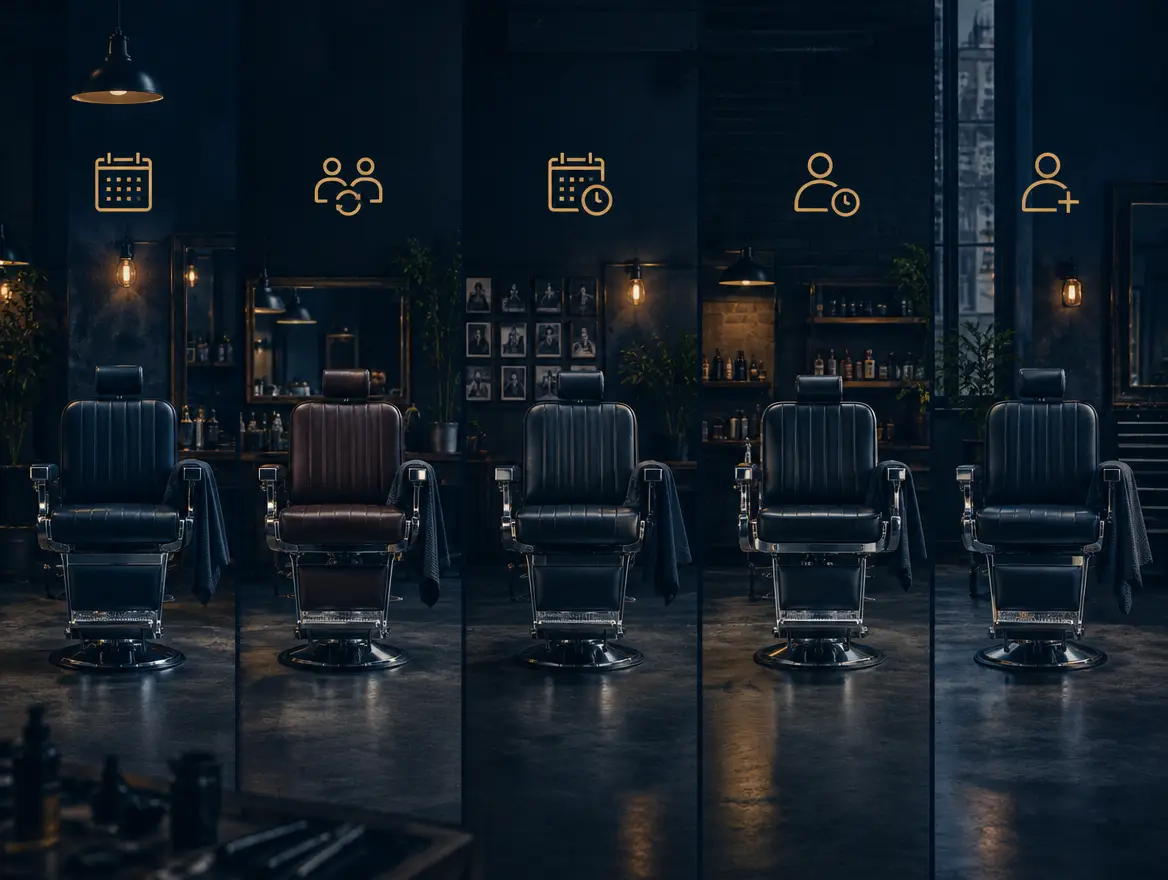
There are five chair types on BarberRise: full-time, trial-to-permanent, rostered, short cover and rent-a-chair. Each suits a different stage of your move. Retraining hairdressers usually do best starting with a structured arrangement, then moving to more independent ones as clipper skills and clientele grow.
Full-time
A full-time chair gives you a steady roster, regular pay and a team around you. It suits hairdressers who want stability while they build clipper speed. You get a consistent walk-in flow and feedback from colleagues every day.
Trial-to-permanent
Trial-to-permanent lets both sides test the fit. The shop sees your cut, the pace and your manner with clients. You see the culture, the clientele and whether the shop delivers on its promises. For a hairdresser changing trades, it is the lowest-risk way to prove the move works. Ask what "permanent" means and when the review happens.
Rostered and short cover
Rostered chairs give you set days, which suits those with family commitments or a second job. Short cover fills a gap, such as a holiday or a resignation. Both are useful for trying a new state without a long commitment, and for meeting shops that might hire you later.
Rent-a-chair
Rent-a-chair means you run your own business inside someone else's shop. You pay for the space and keep what you earn. It carries more risk and more upside, and it is not employment, so award conditions do not apply in the same way. Be careful: the Fair Work Ombudsman warns against sham contracting, where an employee is labelled a contractor. For a hairdresser new to clippers, it is rarely the best first move.
How to choose
Match the chair to your confidence. If you have limited clipper hours, choose full-time or trial-to-permanent. If you already have a following, rostered or rent-a-chair gives you more control. Hire your way, and find your chair.
For Shops: How to Write a State-Wide Listing That Reaches Retraining Hairdressers
A state-wide listing works when it names the chair type, shows pay, welcomes retraining hairdressers and describes what support you offer. Hairdressers scanning a state view want to know they will be taken seriously. Be specific about the chair, and the right people will self-select.
Say you welcome hairdressers
Many hairdressers assume barbershops only want barbers. Put a line in the listing such as "Qualified hairdressers retraining for clipper work are welcome." It widens your pool at no cost, and it signals that you will train.
Show pay and the chair type
State the pay structure, the hours and the chair type in the first few lines. Hairdressers comparing states are weighing a move, and they will skip listings that hide the basics. On BarberRise, pay is shown up front for this reason.
Describe the support
Explain what a new hairdresser gets: a mentor, a ramp-up period, a review date. Our founder's academy experience taught us that training without retention is expensive, so tell applicants what the path looks like in your shop.
Be clear on location and relocation
If you are in a regional pocket, say so, and say whether you can help with housing leads or a flexible start. State-wide listings often reach people who have not yet moved. Shops can see barbers heading to their city before those barbers reach the open market.
What it costs
Posting a role is free. Commission is 0% and never a percentage of wages. The first placement is free for founding shops. Credentials are checked before a profile shows as verified, so you are not sifting through unscreened applicants.
Why We Built a Board for One Trade, Not Another Seek
Generic boards were built for every job, so they are not built for chair-based work. Our founder has ten years in the trade and has managed three shops. He has seen what it costs to hunt through Facebook groups, DMs and generic boards for a barber who can actually cut.
We are not Seek. We are not Indeed. We are only for barbers and barbershops. A role goes straight to barbers already screened for it, with portfolio and experience attached. That matters most for hairdressers changing trades, because a generic board will bury a hairdresser's application under hundreds of unrelated ones.
The contrarian part of our view is about education. Most of the trade says barbers need technique and hustle. We think that is how people burn out by year five. A career behind the chair, not just a grind, needs health, ergonomics, business skills and community. Skills get you started. A community gets you further.
The state view is the first step in that journey. Choose your state, narrow to a city, then find your chair.
Hairdressers: create a profile and browse barbershop chairs in your state, with pay shown up front. Shops: post a role free, with 0% commission. It is three steps, on both sides of the chair: create your profile, post or browse, connect and work.
References
- Fair Work Ombudsman, Hair and Beauty Industry Award [MA000005] summary
- Fair Work Ombudsman, Independent contractors
- Australian Bureau of Statistics, Australian Statistical Geography Standard (ASGS) Edition 3
Frequently asked questions
Can a hairdresser work as a barber in Australia?
Yes. Many hairdressers move into barbershop chairs. Your scissor skills and client care carry over, but you will need clipper control, fades and beard work. Shops usually test these at a trade test, so practise before you apply. A trial-to-permanent chair is a low-risk way to prove the move.
Which state has the most hairdressing and barbershop jobs?
NSW, VIC and QLD have the largest populations and the largest metro markets, so they usually have the most shops. We do not quote vacancy numbers because they change daily. Check live roles for the state you are considering, and compare them with local living costs.
Can I use my hairdressing qualification in another state?
Hairdressing qualifications are nationally recognised, so you do not need to retrain when you cross a state border. Check any local health and hygiene requirements with the relevant council or state body. If you are moving from overseas, speak to a registered migration agent, because BarberRise does not give visa advice.
Does the Hair and Beauty Industry Award apply in every state?
It applies nationally to most employers in the industry, so award minimums do not change by state. Pay above the award varies by shop and location. A small number of employers in WA may fall under the state system, so check with the Fair Work Ombudsman. Rent-a-chair arrangements are a different, contractor-based deal.
How much does it cost shops to post on BarberRise?
Posting a role is free, and commission is 0%. We never take a percentage of wages. The first placement is free for founding shops. Pay is shown up front on every listing, and credentials are checked before a profile shows as verified.
Find a chair near you
Every city, by state: barber jobs in Australia and hairdressing jobs in Australia. Pay floors and how each pay structure works: what barbers get paid.
Barber jobs by city

BarberRise
The team building Australia's job platform for barbers and barbershops.
Keep reading
hairdressing jobs Australia
Hairdressing Jobs in Australia: A City-by-City Hub for Hairdressers Moving Into Barbershop Chairs
14 min read
Afro and textured hair barber jobs
Afro and Textured Hair Barber Jobs: How to Find or Fill a Textured Hair Chair in Australia
16 min read
barber jobs Australia
Barber Jobs in Australia: Your Hub for Finding the Right Chair in Every City and Region
15 min read