
Salon manager jobs in Australia lead into barbershop manager roles when you can already run a floor: rostering, client retention, stock and team culture. The gaps are usually clipper work, fades and walk-in pace. BarberRise lists barbershop manager roles with pay shown up front, so you can compare real offers before you apply.
If you manage a salon or work as a senior hairdresser, you have probably searched "salon manager jobs" and scrolled through a wall of listings. Retail supervisors, spa coordinators, beauty clinic managers and franchise roles all sit in the same results. Very few of them tell you what the job pays or what kind of chair comes with it.
This guide is for salon managers and senior hairdressers who could run a barbershop floor, and for shop owners who want to hire one. I am the founder of BarberRise. I have spent ten years in the trade and managed three shops, so this comes from the floor, not a recruitment desk. Below you will find what the role involves, which skills carry over, how pay and chair types work, where the roles are, and how to apply or post.
Key Takeaways
- A barbershop manager role is a floor leadership job built around walk-in flow, chair utilisation, rostering, stock and culture.
- Client retention and team leadership carry over from salon management. Fades, clipper work and walk-in pace are the usual gaps.
- Pay should be visible in the ad. If a listing hides it, you lose time before you learn the offer is not worth it.
- Manager roles can come as full-time, trial-to-permanent, rostered, short cover or rent-a-chair arrangements. Most manager roles are employment, so check the terms carefully.
- Verified credentials and portfolios save shop owners hours of sifting before the first interview.
- Posting a role on BarberRise is free, commission is 0% (never a percentage of wages), and founding members on Shop Pro get their first placement free.
Built only for barbers and barbershops
Barbers: tell us where you want to cut and when, and shops see you first. Shops: post a role free, and pay one flat fee only when you hire.
Get startedSummary Table
| Area | Salon manager role | Barbershop manager role | What it means for you |
|---|---|---|---|
| Appointment flow | Mostly booked, longer services | Mix of bookings and walk-ins, shorter services | Rostering becomes about demand curves, not just diaries |
| Revenue driver | Colour, treatments, retail | Repeat cuts, fades, beard work, grooming | Chair utilisation matters more than service mix |
| Skills that carry over | Team leadership, retention, stock, rostering | The same, applied to a faster floor | You start ahead of a first-time manager |
| Common gaps | Clipper work, fade standards | Clipper work, fade standards, walk-in pace | Plan short upskilling before you take the keys |
| Culture | Often service and consultation led | Often community and chair-presence led | Your leadership style needs to suit the room |
| Where to search | Generic boards with mixed trades | Trade-only platform with pay up front | Fewer irrelevant listings, clearer offers |
What does a barbershop manager actually do compared with a salon manager?
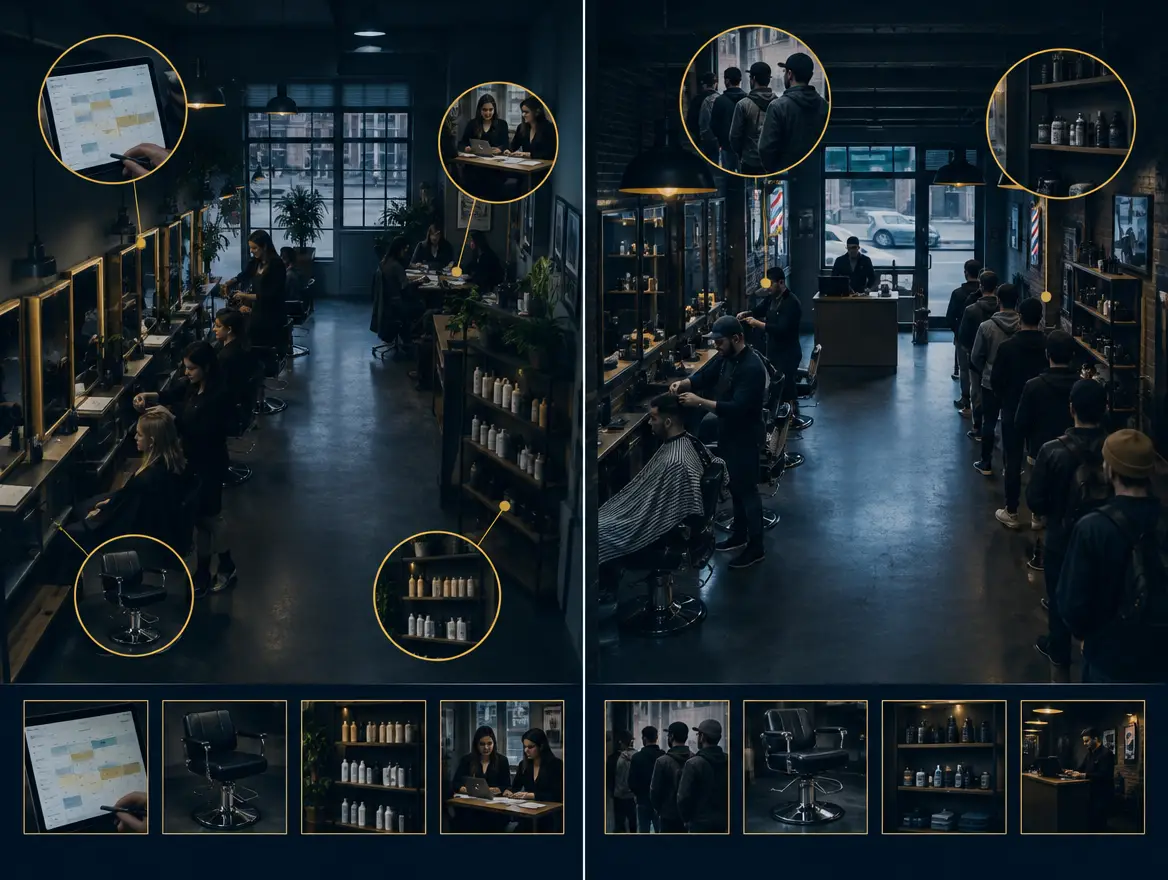
A barbershop manager runs the floor, not just the team. The job covers rostering around walk-in demand, keeping chairs earning, ordering stock, setting standards and holding the culture together. A salon manager does much of this too, but the rhythm differs because barbershop work leans on shorter, repeat cuts and walk-ins.
Rostering and walk-in flow
In a salon, the diary tells you most of what the day will look like. In a barbershop, the diary is only part of the picture. Walk-ins arrive in waves: before work, at lunch, after school, and all day Saturday. A good manager learns those waves and rosters to them.
That means knowing when to stack chairs and when to run lean. It also means deciding how the shop handles a queue. Do you book first and take walk-ins around the gaps? Or do you run a hybrid? There is no single right answer, but the manager owns the answer.
Chair utilisation
A barbershop earns when chairs are occupied. An empty chair earns nothing, and a barber waiting for the next client is a cost you carry. Chair utilisation is the quiet metric behind most shop performance. As manager, you watch gaps in the day, no-shows, late starts and the barbers who consistently run under capacity.
A full shop runs itself. An empty chair runs you. That line is not a slogan, it is how the week feels when you are the one responsible for the numbers.
Stock, standards and the daily open
Stock in a barbershop is different from salon retail. You are managing clipper blades, razors, capes, neck strips, disinfectant, styling products and beard care. Running out of a consumable mid-Saturday is a leadership failure, not bad luck.
Then there is the open. Many shops start early. Someone has to unlock, check the floor, make sure the first client is looked after and set the tone. I know this well from running a shop on the Gold Coast, where early opens and no-shows were part of the weekly reality. The manager is the person who absorbs that so the barbers can cut.
Team culture
Barbershops run on culture more than most salons do. Barbers share a small space, talk all day and compete for the same walk-ins. A manager who ignores that will lose good people quietly. A manager who builds a room where barbers want to be gets retention that no job ad can buy.
Which salon manager skills transfer, and what gaps will you need to close?
Client retention, team leadership, rostering, stock control and complaint handling carry straight over from salon management. The usual gaps are technical: clipper work, fade standards and the pace of a walk-in floor. Most are fixable with focused upskilling, and you do not need to be the best fader in the shop.
What carries over
If you have managed a salon team, you already hold the harder skills to teach. You know how to give feedback without losing a stylist. You know how to handle a client who is unhappy with a result. You can read a roster and spot where the week will break.
Retention is the big one. A salon manager who has kept clients coming back and kept staff for years has proven something a shop owner cannot easily test in an interview. Shop owners can teach a manager the till system. They struggle to teach someone how to keep a team together.
What you may need to build
Be honest with yourself about the technical side. Barbershop clients judge a fade quickly, and barbers judge a manager who cannot hold a clipper. You do not need to be the top cutter on the floor, but you need enough credibility to speak the language and check standards.
The common gaps are:
- Clipper and fade work: consistent blending, clean lines and speed on a short back and sides.
- Beard and razor work: often a service line of its own, with its own hygiene requirements.
- Walk-in pace: managing a queue, setting expectations and keeping quality when the floor is busy.
- Barbershop language and culture: the way clients and barbers talk about cuts is different from a salon consultation.
Closing the gap without starting over
A realistic plan is to spend a short period working a chair alongside the role, or to negotiate a trial-to-permanent arrangement that lets both sides test the fit. That is one reason chair types matter, which I cover below. The point is that moving across is not a step backwards. It is a lateral move that asks you to add a skill set to leadership you already have.
Education matters here too. Skills get you started. A community gets you further. A manager who keeps learning, and who looks after their own body and business knowledge, is still working well in year fifteen. That is the career behind the chair, not just a grind.
How is barbershop manager pay structured?
Barbershop manager pay is usually a base wage or salary, sometimes with a bonus tied to shop performance or a share of takings from your own chair. Structures vary by shop, so the ad should state the pay and the arrangement clearly. For current figures, use the barber salary and pay rates pages rather than guessing.
Common ways manager pay is built
I am not going to quote a salary figure here, because a number pulled from nowhere helps nobody. What I can tell you is how pay tends to be built:
- Base wage or salary: a set amount for managing the floor, which gives you stability.
- Own-chair earnings: if you also cut, you may earn from your own client work on top of, or as part of, the package.
- Performance component: a bonus linked to shop targets, retention or utilisation.
- Other terms: hours, weekend work, early opens, paid leave and any training support.
For current pay ranges across roles, see the barber salary and pay rates pages on BarberRise. The point of keeping that information in its own cluster is that it can be kept current without this article going stale.
Why pay should be visible in the ad
Here is the problem with generic boards. A salon manager can spend an evening applying for roles, then learn in the interview that the package is far from what they expected. That wastes your time and the shop's time.
Pay shown up front fixes it. You self-select. You apply for roles that fit your life and your expectations. Shops get candidates who already accept the range. Nobody wastes a Saturday on a mismatch.
Check the legal side
Employment terms matter. The Hair and Beauty Industry Award 2020 covers many hairdressing and barbering employees, but whether it applies to a particular manager role depends on the classification and the terms. The Fair Work Ombudsman publishes pay guides and award summaries, and it is worth checking them before you sign. If a shop offers you a contractor arrangement for what looks like a managing job, read the Fair Work Ombudsman guidance on independent contractors and ask questions. Fades to Fair Work is a real step in a barber's career: the moment you start thinking about entitlements, not just cuts.
Which chair types can a manager choose?
BarberRise supports five placement types: full-time, trial-to-permanent, rostered, short cover and rent-a-chair. For a manager role, full-time and trial-to-permanent are the most common fit, because managing a team needs consistency. Rostered and short cover suit transitions, and rent-a-chair is rarely a manager arrangement.

| Chair type | How it works | Suits a manager who... |
|---|---|---|
| Full-time | Ongoing employment with set hours | Wants stability and a long-term leadership role |
| Trial-to-permanent | A trial period that can lead to a permanent role | Is moving trades and wants both sides to test the fit |
| Rostered | Set shifts that fit around other commitments | Needs flexibility or is stepping across gradually |
| Short cover | Temporary cover for a gap in the team | Wants a low-commitment look at a shop before committing |
| Rent-a-chair | Independent operator renting a chair | Is building their own book, and is not managing staff |
Both sides choose the chair. That is the core idea behind "Hire your way". A shop can say what it needs, and a candidate can say what suits their life. A salon manager testing the move might take a trial-to-permanent role or a short cover shift first. A shop that has lost its manager might use short cover while it finds the right permanent person.
One caution on rent-a-chair. A manager directs staff and carries responsibility for the shop, which looks like employment. If someone offers you a manager role on a contractor basis, get advice and check the Fair Work Ombudsman guidance before you agree.
Where are barbershop manager roles in Australia?
Barbershop manager roles sit wherever barbershops cluster: the major capital cities, plus strong regional and coastal centres such as the Gold Coast. Rather than repeat every city here, use the hairdressing jobs city-by-city hub and the state hub on BarberRise to see what is open near you.
I will not rank cities or invent role counts, because those figures change weekly and a stale number is worse than none. What I can say is how to approach the search.
- Start with your city. The city hubs list hairdressing and barbering roles by location, so you can see local shops and the chairs on offer.
- Widen by state. If you are open to relocating within your state, the state hub shows the wider picture.
- Look at local employers. The prominent local barbershop employers pages show which shops hire repeatedly, which tells you something about how they treat staff.
- Check senior roles. If you are not ready to manage, the senior stylist jobs pages show a middle step with more responsibility.
If you are moving from overseas, the picture is different. Barbers from the UK, Canada and New Zealand can tell shops where they are heading and when, months before they land. That helps shops plan. BarberRise never gives visa advice. Visa questions always go to a registered migration agent, and you can check an agent's registration through the Office of the Migration Agents Registration Authority (OMARA). The barber relocation and visa sponsorship pages explain what the platform does and does not cover.
What job post details should a barbershop manager ad include?
A strong manager ad states the pay, the chair type, the hours, the shop's location and size, the team the manager will lead, and the credentials required. It also explains what the manager owns day to day. Candidates should be able to judge fit in two minutes, without a phone call.
This section is for shop owners. Most job ads for managers read like a list of duties copied from somewhere else. They attract a pile of applications from people who have not read past the title. Here is what a useful ad includes.
The job post checklist
- Pay and structure. State the base, any bonus and how own-chair earnings work. Hiding pay makes good candidates assume the worst.
- Chair type. Say whether it is full-time, trial-to-permanent, rostered, short cover or rent-a-chair. Be clear if you would consider a trial first.
- Hours and roster. Include opening times, weekend expectations and any early starts.
- Shop profile. Give the suburb, the number of chairs, the client base and whether you run walk-ins, bookings or both.
- Team. Say how many barbers the manager will lead and what the current culture is like.
- What the manager owns. Rostering, stock, standards, onboarding, client complaints, reporting. List the real ones.
- Technical expectations. Say whether you expect the manager to cut, and at what level. This is where salon managers will decide if they are a fit.
- Credentials and licensing. State what you need to see. Say clearly that you check them before interview.
- Growth path. Is there a route to area manager, partner or ownership? Say so, or say there is not.
Write for the manager you want
If you want a salon manager with strong retention skills, say so. If you want a head barber who also manages, say that. A role that tries to cover both without saying which usually ends up with neither. Be direct about what you will teach and what you expect them to arrive with.
Why do verified credentials matter before you interview?
Verified credentials matter because they remove the first round of sifting. When qualifications, experience and portfolio are checked before a profile shows as verified, you spend interview time on leadership and fit, not on whether a claim is true. That is faster for the shop and fairer for honest candidates.
A generic job board gives you a CV and a cover letter. Neither tells you whether the person can run a floor. You spend hours reading, calling and scheduling, and then you find out in the interview that the story does not match.
On a board built for one trade, the process runs differently. Roles go straight to barbers already screened for them. Applications arrive with portfolio and experience attached. Shops can also see barbers moving to their city before those barbers reach the open market. For a manager hire, that matters: you want candidates who can show their floor leadership, not just describe it.
For candidates, being verified is an advantage. Anyone can write "managed a team of ten" on a CV. A verified profile with real portfolio work and checked experience stands out from the pile. If you are a salon manager crossing into barbering, a verified profile also lets you show what you bring without pretending to be something you are not.
How do you apply or post on BarberRise?
BarberRise runs on three steps for both sides: create your profile, post or browse, then connect and work. Candidates build a verified profile and choose the chair type they want. Shops post a role for free, with pay shown up front, 0% commission, and the first placement free for founding members on Shop Pro.
We're not Seek. We're not Indeed. We're only for barbers and barbershops. That is the whole point. Only barbers, only barbershops. You are not wading through retail, beauty and spa listings to find the one chair that fits.
Three steps. Both sides.
- Create your profile. Candidates add experience, portfolio and credentials. Shops add their shop details, culture and what they offer.
- Post or browse. Shops post a role with pay up front. Candidates browse roles matched to their profile and chair preference.
- Connect and work. Both sides talk, agree terms and start, whether that is a trial, a full-time role or short cover.
For candidates
Create a verified BarberRise profile and choose the manager chair that suits you. If you are not sure you are ready to run a shop, start with a trial-to-permanent role or short cover. If you want to build skills first, look at the education tier of the platform. Find your chair, and build from there.
For shop owners
Post your manager role free, with pay shown up front and 0% commission. Commission is never a percentage of wages. Founding members on Shop Pro get their first placement free. There is no agency cut, no hidden fee and no hours of sifting through unscreened applicants.
Behind the placement sits a bigger idea: three tiers of the platform. Community, education and job placement. Recruitment alone does not keep a shop full. Retention, skills and a network around the shop do that.
What actually separates good shop managers from poor ones
After ten years in the trade and three shops managed, I can tell you the best managers were not the best cutters. They were the ones who kept the floor steady, looked after their people and told the truth early. Poor managers did the opposite: they hoarded the best clients, avoided hard conversations and let small problems grow.
Here is what I saw, shop after shop.
Good managers protect the roster before it breaks. They notice when a barber is burning out, when a chair has been empty too often, or when two people are heading for a clash. They act in week one, not week eight.
Good managers share the good clients. A poor manager keeps the best walk-ins and the best books for themselves. The team sees it within a month. A good manager builds other people's books, because a shop full of busy barbers is a stable shop.
Good managers have the hard conversation. Late starts, standards, a barber who is rude to clients. A poor manager waits and hopes. A good manager deals with it kindly and quickly.
Good managers know the cost of losing people. When I ran an academy inside my Canadian shops, I trained barbers from scratch and invested in them properly. Within months, some were poached. It taught me something I still hold: training people and then losing them is expensive, so the manager's job is to build a place people want to stay. Pay matters, but so do growth, respect and a room that feels like a team.
Good managers stay close to the chair. At Black Sheep Barbershop on the Gold Coast, the hardest part of ownership was stepping away from the chair while keeping every chair filled. A manager who can step back without the floor dropping is worth a great deal. That is why I built BarberRise inside my own shop: so shops could hire from barbers already screened for the chair, instead of hunting through Facebook groups, DMs and generic job boards.
If you are a salon manager, you probably already have most of these instincts. That is the real reason your skills transfer. The clipper work can be taught. The judgement is much harder to teach.
Master your craft, grow your shop. And if you are the one running it, Rise together.
References
- Fair Work Ombudsman, Hair and Beauty Industry Award [MA000005] summary
- Fair Work Ombudsman, Independent contractors
- Office of the Migration Agents Registration Authority (OMARA), Find a registered migration agent
Frequently asked questions
What does a barbershop manager do?
A barbershop manager runs the floor. That includes rostering around walk-in demand, keeping chairs occupied, ordering stock, setting standards, handling client issues and building team culture. Some managers also cut. The exact mix depends on the shop, so the job ad should say what the manager owns.
Can a salon manager become a barbershop manager?
Yes. Client retention, team leadership, rostering and stock control carry over directly. The usual gaps are clipper work, fade standards and walk-in pace. A trial-to-permanent or short cover arrangement lets you test the fit and build those skills while still earning.
How much does a barbershop manager earn?
It varies by shop, location and arrangement, so a single figure would mislead you. Pay is usually a base wage or salary, sometimes with own-chair earnings or a performance bonus. Check the barber salary and pay rates pages on BarberRise, and look for ads that show pay up front.
Do I need to be able to cut fades to manage a barbershop?
Not always, but you need enough technical credibility to set standards and earn the team's respect. Some shops want a cutting manager. Others want a floor leader who oversees the barbers. Read the ad carefully and ask the shop what it expects.
Is it free to post a manager role on BarberRise?
Yes. Posting a role is free, commission is 0% (never a percentage of wages), and founding members on Shop Pro get their first placement free. Pay is shown up front, and roles go straight to barbers already screened for them.
Find a chair near you
Every city, by state: barber jobs in Australia and hairdressing jobs in Australia. Pay floors and how each pay structure works: what barbers get paid.
Barber jobs by city

BarberRise
The team building Australia's job platform for barbers and barbershops.
Keep reading

top hiring suburbs for barbers
Top Hiring Suburbs for Barbers in Australia: Where Shops Are Filling Chairs and How to Find Them
16 min read

Afro and textured hair barber jobs
Afro and Textured Hair Barber Jobs: How to Find or Fill a Textured Hair Chair in Australia
16 min read

current barber vacancy counts
Current Barber Vacancy Counts: How to Read Live Job Numbers on City and Region Hubs
15 min read