
Barber pay in Australia varies by city, shop model and pay structure, not just a salary figure. The Hair and Beauty Industry Award sets the legal floor for employees, and Fair Work publishes current rates. Above that floor, pay depends on metro or regional demand, experience, skills and whether you are paid hourly, on commission or renting a chair.
I spent ten years in the trade and managed three shops. I have sat on both sides of the pay conversation: the barber asking what the chair is really worth, and the owner trying to fill it without wrecking the margin. Most of those conversations went badly for one simple reason. Nobody was comparing like with like.
This guide explains why local barber salary data is so hard to find, what actually moves pay from Sydney to Perth to regional towns, and how to compare any offer fairly. It also shows how to use pay-up-front listings as live local data, and what shop owners should do to price a chair that attracts the right barber.
Key Takeaways
- Barber salary data is patchy because general job boards hide pay and group barbers with hairdressers and salon staff.
- The Hair and Beauty Industry Award is the legal floor for employees. Check Fair Work for current rates rather than trusting a blog post, including this one.
- Hourly, commission, hybrid and chair rental models are not comparable until you convert each to expected weekly take-home after costs.
- Chair type (full-time, trial-to-perm, casual, rental) changes your income security as much as your headline rate.
- A posted rate is an offer, not an average. Compare several listings in one city and look for outliers.
- Shop owners who show pay up front get better-matched applicants and waste less time sifting.
Built only for barbers and barbershops
Barbers: tell us where you want to cut and when, and shops see you first. Shops: post a role free, and your first placement is free as a founding shop.
Get startedSummary Table: How Barber Pay Models Compare
| Pay model | Income certainty | Upside for a busy barber | Who carries the quiet-day risk | Typically suits |
|---|---|---|---|---|
| Hourly (award or above) | High | Limited unless rate is well above the floor | Shop | Newly qualified barbers, those building a book |
| Commission split | Lower | High | Mostly the barber | Established barbers with a loyal clientele |
| Hybrid (base plus commission) | Medium to high | Medium to high | Shared | Barbers moving shops or cities |
| Chair rental | Lowest | Highest | Barber | Experienced barbers running their own business |
| Tips (on top of any model) | Unpredictable | Varies with clientele and shop culture | Barber | Everyone, but never budget on them alone |
Why is local barber salary data so patchy?
Barber salary data is patchy because most job boards hide the pay, and most salary aggregators lump barbers in with hairdressers and salon staff. The result is an average that describes a different job, in a different shop model, often in a different city. It tells you little about the chair you are considering.
There are three problems stacked on top of each other.
Hidden pay. Many general listings say "competitive rate" or "negotiable". That wording protects the advertiser, not the barber. You invest time in an application and a trial before you learn whether the money works.
Barbers grouped with hairdressers. According to the Australian Bureau of Statistics, its occupation classification (ANZSCO) places barbers alongside hairdressers (see the ABS link in the references). That is fine for national statistics. It is not useful when you want to know what a skin fade specialist on a commission split earns in a busy city shop compared with a salon colourist on a salary.
Self-reported averages. Crowd-sourced salary pages mix full-time employees, casuals, commission earners and people who report one good week. They rarely say which pay model sits behind each figure. A number with no pay structure attached is close to useless.
The fix is not a bigger average. It is local, current, structured data: a real rate, for a real chair type, in a real suburb, shown before you apply. That is how I think about pay-up-front listings, and I cover how to use them below.
What shapes barber pay in each Australian city?
Four things shape barber pay city by city: the legal floor set by the award, how hard shops compete for barbers locally, your experience, and the skills you can charge a premium for. Rent and cost of living push rates up in some places, while thin local talent pools do it elsewhere.
The award is the floor, not the market
For employees, the Hair and Beauty Industry Award is the legal minimum. It sets base rates by classification, plus penalty rates and other entitlements, so a shop cannot lawfully pay an employee below it. I am deliberately not quoting dollar figures here because the rates are reviewed and change. Check Fair Work for current rates using the Fair Work Ombudsman pay guide and the award summary linked in the references.
Two cautions. First, the award floor tells you what an employee must be paid, not what the local market pays. In a city with strong demand, the market rate for a good barber sits above it. Second, if a shop calls you a contractor, that is a different arrangement with different obligations. The ATO and Fair Work both publish guidance on the difference, and it is worth reading before you sign anything.
Metro versus regional demand
Metro and regional pay behave differently for different reasons.
- Sydney and Melbourne: Large talent pools and a lot of competing shops. Barbers can shop around, so strong operators often compete on the offer and the quality of the room, not only the rate. Rents and living costs are also high, which pushes people to look hard at take-home after costs.
- Brisbane and the Gold Coast: Growing populations and plenty of new shop openings. I ran Black Sheep Barbershop on the Gold Coast, and the hardest part was never finding customers. It was keeping every chair filled with someone reliable.
- Perth: A more self-contained market. Moving there from the east coast or overseas means checking local rates rather than assuming they match.
- Regional towns: Fewer barbers, so a good one has leverage on terms, hours and sometimes rate. But the customer base is smaller, so a commission-only deal can be thin.
I have not put averages against these cities because I would be guessing. What I can say is that the same pay model can mean very different outcomes in each place. That is why you compare structure first, then the rate.
Experience level
Pay moves with how much you can produce and how little supervision you need. A newly qualified barber is usually building speed and a book of regulars. A barber with several years behind the chair brings a clientele, so a commission split or rental starts to make sense. Shops pay more for someone who can fill their own diary on day one.
Skill premiums: fades, straight razor and textured hair
Skills the shop can sell at a higher service price tend to earn a premium, either in the rate or the split:
- Fades: The core skill. Clean, consistent fades keep a chair booked. They are expected, so they rarely earn a premium on their own, but weak fades cost you work.
- Straight razor and beard work: Slower services that customers pay more for. A barber who can sculpt a beard properly and finish with a razor lifts the shop's average ticket.
- Textured and curly hair: A real gap in many markets. Barbers who can work confidently across hair types widen the customer base for the shop, and owners should value that.
If you hold one of these skills, put it in your profile and ask about it in the offer. Fades to Fair Work: the craft sets your value, and the award protects the floor beneath it.
How do barber pay structures work, and how do you compare them?
Barbers are paid by hourly wage, commission split, a hybrid of base plus commission, or by renting a chair and keeping what they earn after the fee. To compare them fairly, convert each to expected weekly take-home after costs, using realistic bookings rather than best-case weeks.
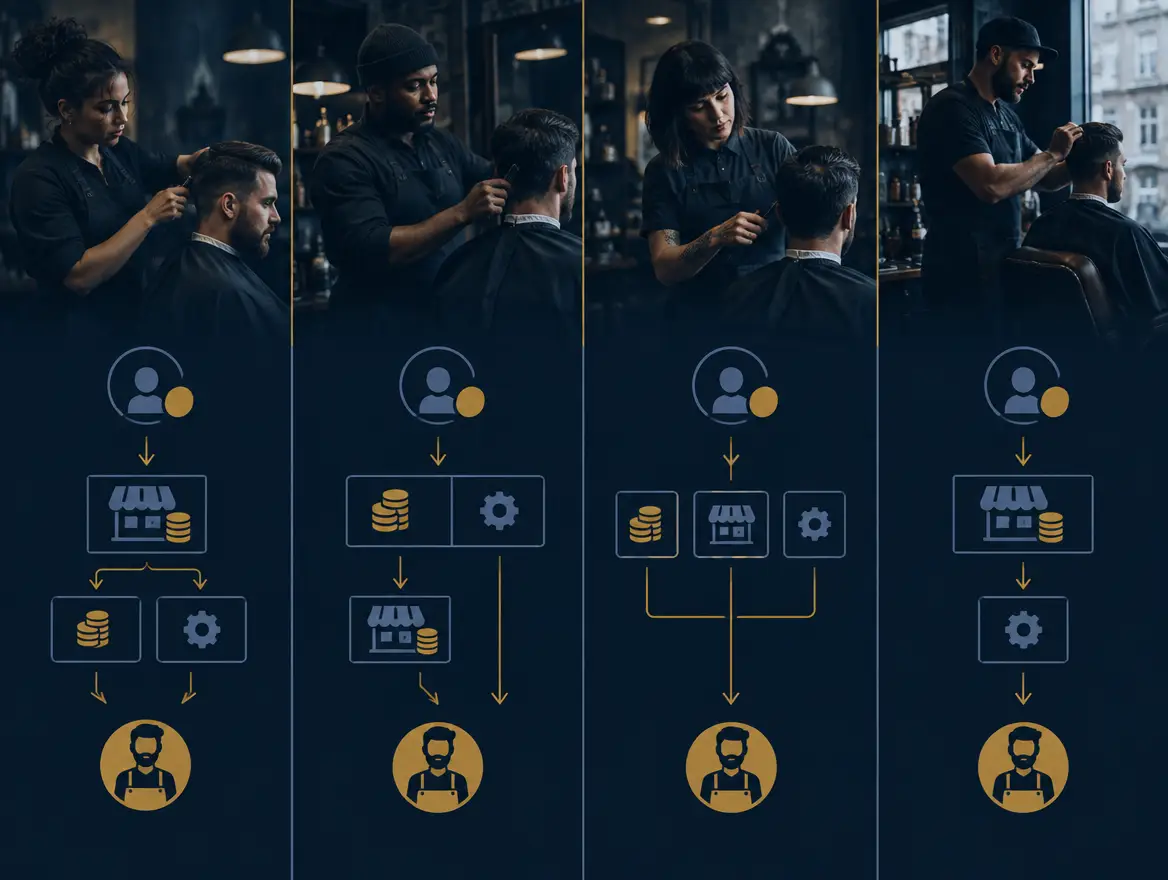
The five structures decoded
Hourly. You are paid for hours worked, usually at or above the award. It is predictable, and you are paid on quiet days. The trade-off is that a fully booked day earns you the same as a slow one.
Commission split. You earn a percentage of what you bring in. Strong barbers can earn well, but income swings with bookings. Ask whether the split is on service revenue before or after product, card fees and other deductions. Also ask whether a minimum wage guarantee sits underneath. For employees, the award floor still applies, so a commission arrangement should not leave you under it. Confirm how that works with the shop and with Fair Work.
Hybrid. A base wage plus commission above a target. This is the model I rate for barbers moving shops or cities, because it protects you while your book rebuilds.
Chair rental. You pay the shop a fee and keep your service income. You get independence and upside, and you carry the quiet days, your own insurance, tax and supplies. It is a business, not a job. Check the ATO guidance on contractors before you take one on.
Tips. Tips depend on clientele, shop culture and payment method. Ask how they are handled before you start. I would never budget on them.
A simple method for comparing offers fairly
Put every offer through the same five steps.
- Estimate your realistic weekly bookings. Use a normal week, not your best one. If you are new to the shop or city, assume it takes time to fill your diary.
- Work out your gross. For hourly, that is rate times hours. For commission, it is average service price times bookings times your split. For rental, it is your service income before the fee.
- Subtract the costs the offer pushes onto you. Rental fees, product, tools, card fees, insurance, and travel or relocation.
- Add the entitlements that come with it. For employees, that includes leave and superannuation. For contractors, remember you fund those yourself.
- Check the downside week. What do you take home if you are sick or the shop is quiet? If you cannot answer that, the offer is incomplete.
Two offers with different headline rates can land closer together than you expect once you run them through this. Sometimes the lower rate with more security is the better deal, and sometimes it is not. The method just makes it visible.
How does chair type affect take-home pay?
Chair type changes your take-home through security, not just rate. A full-time role gives steady income and entitlements, trial-to-perm tests the fit before you commit, casual work trades security for flexibility, and rent-a-chair hands you the upside and the risk. Pick the type that fits your clientele and life.
BarberRise supports five placement types: full-time, trial-to-permanent, rostered, short cover and rent-a-chair. Here is what each means for your pay.
- Full-time: The most predictable. Suits barbers who want stable income and a base to build a clientele.
- Trial-to-perm: Both sides test the fit. Ask what the pay is during the trial, how long it runs and what changes on conversion. A trial should be paid at a rate that matches the work.
- Rostered and casual: Flexible, often useful for barbers juggling study, a second job or a move. Weekly income varies with the roster, so check the hours you can realistically expect.
- Short cover: Good for barbers who are travelling or between shops, and for getting a feel for a city before committing.
- Rent-a-chair: Highest ceiling and highest risk. It works when you already have regulars. It is a hard first step for someone who has just qualified.
If you are early in your career, a paid, structured start such as an apprenticeship or a trial-to-perm role usually beats rental. If you have a loyal clientele and want to keep more of what you earn, rental can pay better, as long as you have costed the quiet weeks.
How can pay-up-front listings work as live local salary data?
Pay-up-front listings work as live salary data because every posted role shows a real rate, a chair type and a location, and you can compare several in one city. Read enough of them and you can see the usual range, spot the outliers and judge any new offer against what shops are actually advertising.

This is what generic boards cannot give you. Only barbers, only barbershops: when every listing is for a chair, the data is about chairs. Here is how I would use it.
- Open a city hub. Browse the listings for the city you work in or want to move to, such as Sydney, Melbourne, Brisbane or Perth.
- Filter by chair type. Compare full-time with full-time and rental with rental. Never mix them.
- Note the posted rates and the structure behind them. Is it hourly, a split or a hybrid? Write down the pattern you see.
- Find the middle of the pack. After you have looked at enough listings, most of them cluster. That cluster is your working local range.
- Spot the outliers. A rate far above the cluster might include a heavy rental fee or a thin guarantee. A rate far below might be an old listing, a training role or a shop that will struggle to keep staff. Read the detail before you judge.
- Check the shop, not just the number. Look at hours, location, specialties wanted and whether the barber side is verified.
One honest caveat: a posted rate is an offer, not an average. A handful of listings is a snapshot, not a survey, and I would not present it as one. The value is that it is current and local, so it ages far better than a salary page last updated years ago.
If you are moving from the UK, Canada or New Zealand, you can also tell shops where you are heading and when, so they can see you before you reach the open market. BarberRise never gives visa advice. Those questions always go to a registered migration agent.
Barbers use this to find their chair. The same approach follows the platform's "Three steps. Both sides." model: create your profile, post or browse, then connect and work.
For shop owners: how do you price a chair to attract screened barbers?
Price a chair by starting at the award floor for employees, then adjusting for your city's competition, the experience you need and the skills you want. Show the rate in the listing. Barbers skip vague ads, so clear pay brings better applicants and shortens the time to fill the chair.
A full shop runs itself. An empty chair runs you. I know that from the 6am opens, the no-shows and the staff hunts at Black Sheep Barbershop. Here is how I would price a chair now.
- Start with the legal floor. Check Fair Work for current rates for the classification you are hiring. Do not guess, and do not pay under it.
- Look at your local market. Browse your city hub and see what comparable shops post. If you are below the cluster, expect fewer and weaker applicants.
- Pay for the skill you need. If you want a straight razor and beard specialist, or someone confident with textured hair, say so and price for it.
- Pick the structure that matches your shop. A new barber usually suits hourly or hybrid. An established barber with regulars may want a higher split or a rental.
- Be honest about hours and conditions. Early opens, weekend rosters and a quiet first month matter as much as the rate.
- Show the pay in the listing. It filters out people who will never accept it, and your time goes to barbers who are a fit.
On cost: posting a role on BarberRise is free, and the first placement is free for founding shops. BarberRise charges 0% commission and never takes a percentage of wages. Some agencies charge a percentage of the wages for a placement, and that cost is real. On a well-paid chair it adds up fast. A flat-free, 0% model means more of your budget reaches the barber. That is "Hire your way": you pick the placement type and the structure, and the platform does not skim the wage.
The cheapest barber is the one you keep: what pay data misses
Pay data misses retention. The highest advertised rate is not always the best-paid chair, and the lowest is not always the worst. What decides whether a barber stays, and whether a shop stays profitable, is the full package: training, hours, culture, structure and a path forward.
I learned this in Canada. I ran an academy inside my shops and trained barbers from scratch. I put real time and money into developing new staff. Within months, they were poached. The shop that hired them paid for the training with my effort and got a ready barber on day one.
That changed how I think about pay. If you invest in someone and then lose them to a slightly higher number elsewhere, the number was never the whole story. It is also why I disagree with the common view that barber education should be all technique and hustle. Education should support a career behind the chair, not just a grind. Health, ergonomics, business skills and a clientele you can build all outlast hustle culture, and they are why a barber is still enjoying the trade in year fifteen.
So my advice runs in both directions.
- Barbers: Do not chase the top rate alone. Ask what you are getting beyond it: training, a clear route to a better structure, a shop that will still treat you well when you are busy.
- Owners: If you train people, treat retention as part of the pay offer. A fair structure with a visible path often beats a slightly higher rate with nothing behind it.
Skills get you started. A community gets you further. Pay data is one tool for comparing chairs, and the rest is the career you build around it.
Find Your Chair or Fill Yours
Barbers: browse BarberRise jobs in your city with pay shown up front, and find your chair.
Shops: post your chair free, with 0% commission and your first placement free as a founding shop. Rise together.
References
- Fair Work Ombudsman, Hair and Beauty Industry Award [MA000005] summary
- Fair Work Ombudsman, Minimum wages and pay guides
- Australian Bureau of Statistics, ANZSCO: Australian and New Zealand Standard Classification of Occupations
- Australian Taxation Office, Employee or independent contractor
Frequently asked questions
How much do barbers earn in Sydney, Melbourne and Brisbane?
There is no honest single figure, because pay depends on the pay model, experience, skills and the shop. For employees, the Hair and Beauty Industry Award sets the legal floor, and Fair Work publishes current rates. Above that, compare several current listings in each city by chair type to see the local range.
What is the hourly rate for a barber in Australia?
For employees, the minimum hourly rate comes from the Hair and Beauty Industry Award, based on classification and employment type, and it is updated over time. Check Fair Work for current rates. Many shops pay above the floor for experience and skills, so look at posted rates for your city.
Is commission better than hourly pay for barbers?
Neither is better for everyone. Hourly pay gives certainty, which suits newer barbers or those rebuilding a book. Commission rewards a full diary, which suits barbers with regulars. A hybrid often works well when you are changing shops. Compare them by expected weekly take-home after costs, including a quiet week.
Are barbers covered by the Hair and Beauty Industry Award?
Employees working in barbering are generally covered by the Hair and Beauty Industry Award, but coverage depends on your duties and employment arrangement. Contractors and renters are treated differently. Confirm your classification and entitlements with the Fair Work Ombudsman rather than relying on what a shop tells you.
What should I ask about before renting a chair?
Ask what the fee covers, how it is charged, what you must supply, and what insurance and tax you are responsible for. Work out your break-even bookings per week and what you take home in a slow week. The ATO has guidance on employee versus contractor arrangements.
Does it cost shops anything to post a barber job on BarberRise?
Posting a role on BarberRise is free. The first placement is free for founding shops, and there is no agency commission. BarberRise charges 0% and never takes a percentage of wages.
Find a chair near you
Every city, by state: barber jobs in Australia and hairdressing jobs in Australia. Pay floors and how each pay structure works: what barbers get paid.

BarberRise
The team building Australia's job platform for barbers and barbershops.
Keep reading

barber jobs by skill
Barber Jobs by Skill and City: How to Match Fades, Beard Work and Razor Skills to Local Demand in Australia
16 min read

chair rental opportunities
Barber Chair Rental Opportunities in Australia: How to Find or Fill a Rental Chair
17 min read

Barber colour specialist jobs
Barber Colour Specialist Jobs: How to Find or Fill a Colour Chair in Australia
17 min read